
www.auto-innovations.net
25
'26
Written on Modified on
Off-Road Chassis Architecture for Forest Firefighting Operations
MAN Truck & Bus introduces an all-wheel-drive platform engineered to meet Category 3 off-road standards for emergency vegetation and wildland fire response.
www.man.eu
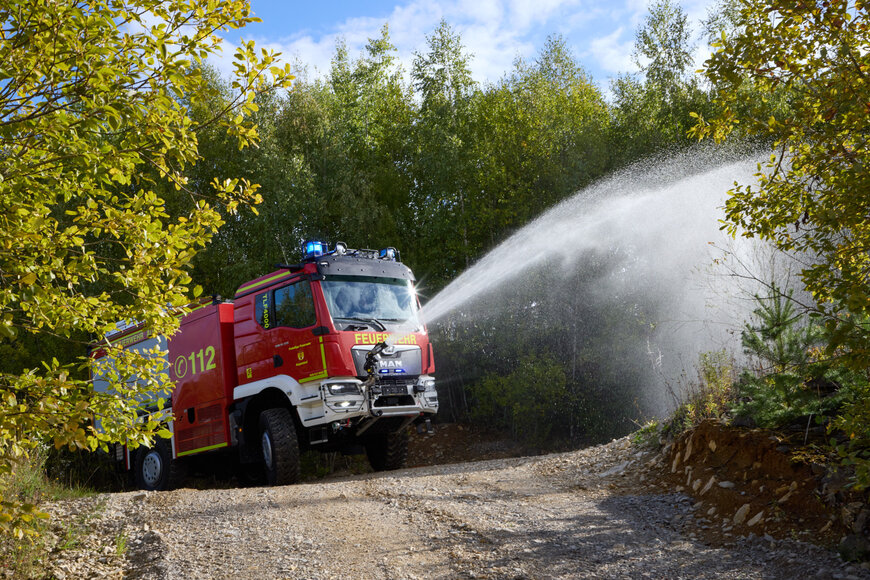
The technical cooperation between MAN Truck & Bus, MAN Individual, and ESTEPE has produced an 18-tonne all-wheel-drive vehicle platform compliant with the highest off-road classification under DIN EN 1846-1. The system is designed for civil protection, disaster response, and municipal fire services requiring high-capacity water transport across unpaved and thermally hazardous terrain.
Chassis Architecture and Payload Capacities for Fire Suppression
The platform utilizes a permanent all-wheel-drive configuration powered by a 320 hp internal combustion engine paired with a MAN PowerMatic automated transmission. Single 14.00 R20 tires fitted across the front and rear axles provide uniform ground clearance and traction across unpaved substrates.
With a gross vehicle weight rating permitting payloads up to 11.5 tonnes, the chassis accommodates tank firefighting superstructures carrying up to 6,000 liters of water and 500 liters of foam concentrate alongside standardized auxiliary gear. The powertrain configuration also supports pump-and-roll operations, maintaining continuous extinguishing output during low-speed tactical vehicle movements along fire perimeters.
Thermal Shielding and Mechanical Protection Mechanisms
To operate in proximity to open flames, vulnerable vehicle networks incorporate localized thermal shielding. Lines carrying compressed air, electrical wiring, diesel fuel, and AdBlue are rated to withstand direct temperatures of 130 degrees Celsius for up to ten minutes. Critical driveline elements, including the transfer case, are fitted with heavy-gauge mechanical underbody plating to prevent impact damage from rocky terrain and debris.
Cabin modifications provide structural safety and tactical utility. A hinged roof hatch positioned between the forward crew positions permits elevated observation and targeted external suppression, supported by an internal height-adjustable platform. The modified cab structure complies with ECE R29-3 crash-safety impact criteria.
Tire Pressure Regulation and Fording Characteristics
Mobility over variable terrain is managed by an integrated tire pressure control system operable directly from the driving station. This setup is paired with run-flat tire inserts and dynamic pressure monitoring, allowing controlled vehicle extraction following catastrophic tire deflation.
For amphibious and water-obstacle crossings, the chassis features an elevated exhaust tailpipe routed behind the cab and elevated breathing apparatus, achieving a maximum fording depth of 950 millimeters.
Superstructure Integration and Field Demonstrations
Demonstration runs conducted at the MAN ProfiDrive facility in Simmelsdorf near Nuremberg validated three superstructure configurations across varied tactical specifications.
The Schlingmann TLF 4000-V utilizes a shortened 3,300-millimeter wheelbase with a single-row TN cab configured for a three-person crew. The ITURRI TLF 4000-V variant employs a 3,900-millimeter wheelbase with a DN crew cab seating six emergency personnel. A third configuration from Schmitz Feuerwehrtechnik integrates a 3,600-millimeter wheelbase with a three-person cab layout, demonstrating adaptability to diverse national brigade operational profiles.
According to Martin Zaindl, Head of Sales Body Builder & Strategic Partners, the chassis provides high off-road mobility and diverse configuration parameters to serve as a standardized base for vegetation firefighting, emergency management, and civil disaster response in off-road environments.
Additional Context
This section details technical specifications and competitive benchmarking not included in the original product announcement.
Heavy wildland firefighting apparatus operating in DIN EN 1846-1 Category 3 (all-terrain) are evaluated on approach and departure angles, ground clearance, wading depth, and payload limits under severe torsion. In the 14-tonne to 18-tonne all-wheel-drive segment, primary European platforms include the Mercedes-Benz Unimog U 5023, the Mercedes-Benz Arocs 4x4, and the Tatra Phoenix 4x4.
While the Mercedes-Benz Unimog U 5023 features portal axles delivering standard fording capabilities of up to 1,200 millimeters, its gross vehicle weight is capped at 14.5 tonnes, limiting maximum water tank capacity to roughly 3,000 to 4,000 liters. The 18-tonne MAN platform trades the specialized portal axle clearance for an 11.5-tonne payload capacity, allowing it to carry up to 6,000 liters of water on an 18-tonne frame. In contrast, the Tatra Phoenix 4x4 utilizes an independent swinging half-axle backbone tube chassis that mitigates torsional stress on mounted superstructures, whereas the MAN TGM relies on conventional rigid-axle leaf suspension adapted for extreme terrain through bespoke engineering partnerships with ESTEPE.
Edited by Evgeny Churilov, Induportals Media - Adapted by AI.
www.man.eu
