
www.auto-innovations.net
02
'26
Written on Modified on
Bidirectional Charging Systems for Electric Fleet Depots
Consortium partners deployed bidirectional charging protocols in the MAN eTGX to enable automated grid stabilization and reduce logistics operating costs.
www.man.eu
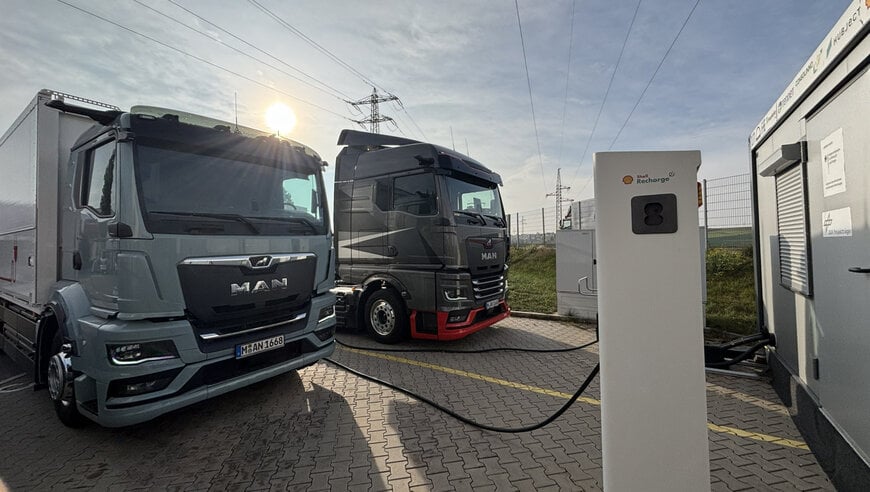
Technical University of Munich, MAN Truck & Bus, and industrial partners concluded the three-year SPIRIT-E project validating bidirectional direct current power transfer for heavy commercial vehicles. Testing confirmed that battery electric trucks can act as distributed energy storage units for local industrial facilities and public transmission networks.
Industrial Integration and Operational Objectives
Fleet electrification requires managed grid connections to mitigate demand peaks and high electricity tariffs. Coordinated by Technical University of Munich, the eight-member consortium addressed these integration challenges across commercial logistics hubs.
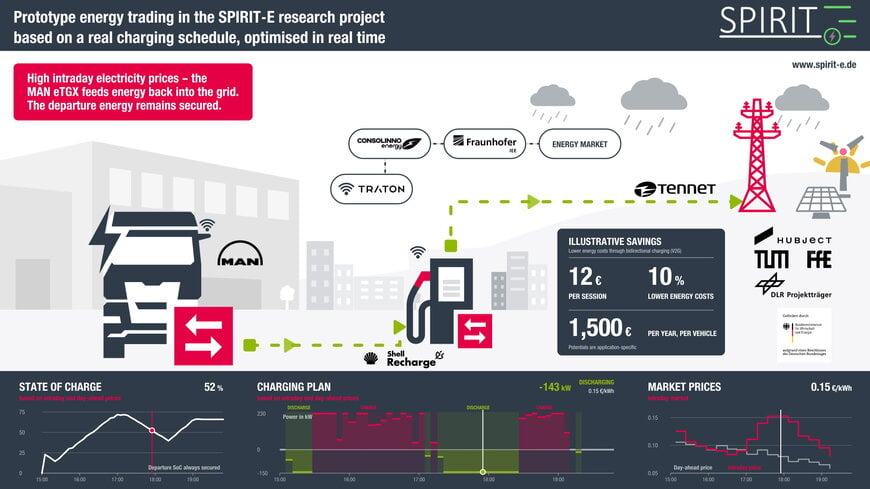
Deploying bidirectional direct current infrastructure requires synchronized communication across multiple operational layers, linking vehicle battery management systems, stationary depot chargers, site energy management systems, electricity aggregators, and transmission system operators.
Technical Architecture and Interface Standards
Testing utilized an electric MAN eTGX equipped with a 480 kWh usable battery capacity paired with stationary and mobile charging systems from SBRS.
Bidirectional communication adhered to the ISO 15118-20 protocol, governing automated physical and digital handshakes between the vehicle and charging infrastructure during alternating charge and discharge cycles. The system delivered power discharge rates reaching up to 350 kW through direct current connections.
The software architecture integrated depot scheduling tools, site load controllers, and third-party market trading interfaces. PowerBot simulation environments modeled spot market price arbitrage, while the European EQUIGY platform coordinated automated telemetry to resolve local transmission bottlenecks.
Depot Deployment and Field Results
Field evaluation occurred at the Schmid logistics depot in Regensburg, testing three bidirectional operational modes:
Vehicle-to-Site (V2S) discharged stored battery energy into the local depot grid to reduce facility peak demand.
Vehicle-to-Grid (V2G) supplied automated balancing power back into the public transmission grid.
Vehicle-to-Vehicle (V2V) transferred direct current energy between commercial vehicles to balance localized fleet states of charge.
Economic parameters demonstrated that vehicles running under 100,000 kilometers annually with predictable idle intervals achieved operational energy expenditure reductions between 10 and 20 percent under optimized market arbitrage profiles.
Implementation Requirements
Georg Grüneißl, Head of Product Strategy at MAN Truck & Bus: "The MAN eTGX has demonstrated that it can serve as a bidirectional energy storage system. We are now working to bring this feature into series production."
Wide deployment requires unified regulatory frameworks for automated spot-market trading, standardized digital integration between logistics planning tools and energy markets, and grid connection policies accommodating high-capacity bidirectional injection.
Consortium participants included Consolinno Energy, Fraunhofer IEE, Hubject, Research Center for Energy Economics, MAN Truck & Bus, Technical University of Munich, TenneT, and SBRS, with public administration by DLR Project Management Agency on behalf of the German Federal Ministry for Economic Affairs and Energy.
Edited by Evgeny Churilov, Induportals Media - Adapted by AI.
www.man.eu
