
Electric Trucks as a Competitive Advantage
The strategic report by MAN Truck & Bus demonstrates, using three international fleets with varying stages of electrification, how early adopters secure a structural advantage.
www.man.eu
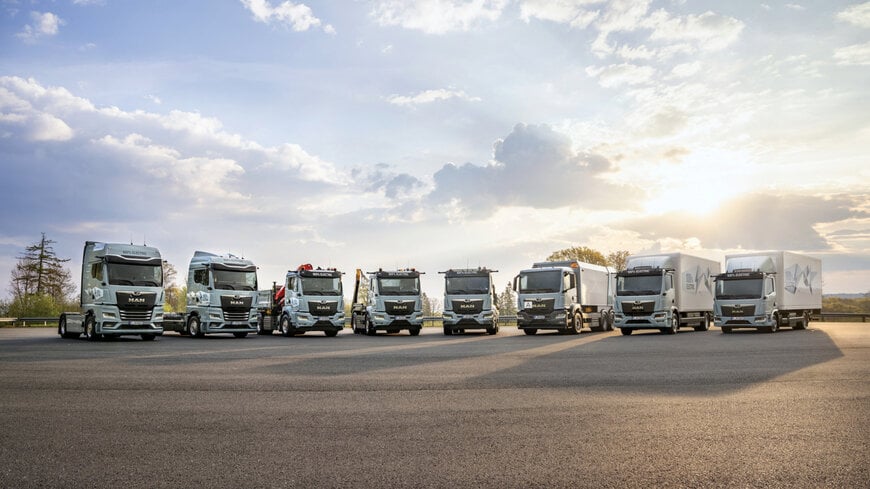
Application Area: Commercial Vehicle Logistics
Industry Sector: Transport and Logistics
The European commercial vehicle market is undergoing a structural transformation: studies indicate that between 15 and 35 percent of newly registered trucks in Europe will be battery-electric starting in 2030. By 2035, an estimated 50 percent of European forwarders and transporters will operate at least one battery-electric truck in their fleet. Electrification is evolving in the medium term into a prerequisite for long-term competitiveness and business success. Electric trucks unlock their economic potential within the depot through smart charging and energy solutions such as photovoltaics and storage. Total cost of ownership advantages of up to 13 percent compared to diesel are achievable after five years.
The strategy report recently published by MAN Truck & Bus illustrates how structural competitive advantages can emerge through the transition to battery-electric trucks—and why eTrucks are increasingly determining access to customers and orders. Battery-electric trucks are no longer a future technology, but rather operational reality: more than 15,000 eTrucks are already driving daily on European roads, operated by around 5,000 forwarders and transporters.
The commercial vehicle market is structurally changing and will continue this development: the EU mandates decreasing fleet CO₂ values for manufacturers (minus 45 percent by 2030 and minus 90 percent by 2040), and an increasing number of shippers are already demanding emission-free transport in their tenders. Electrification is thus shifting from an optional ambition to an obligatory requirement. According to renowned studies, the share of battery-electric new registrations is expected to rise to 15 to 35 percent from 2030.
Starting early with the electrification of depots and fleets often allows companies to profit from higher prices for zero-emission transports, position themselves as a central component of low-emission supply chains, and build the necessary competencies surrounding energy generation and utilization that will be decisive for long-term success.
Overall System Is Decisive
The decisive advantage does not arise in the vehicle alone, but within the overall system comprising the vehicle, depot, and charging and energy management. Total cost of ownership (TCO) is determined by energy prices, charging infrastructure, and toll and CO₂ costs. The largest lever is formed by the depot: up to 90 percent of all charging processes already take place today and in the future at the company's own site, and with photovoltaics, storage systems, and intelligent charging, energy costs can drop to under 16 cents per kilowatt-hour. Over a five-year period, TCO advantages of up to 13 percent compared to diesel can thus be created.
The MAN strategy report "Beyond Diesel" documents that this is already functioning today using three real customer archetypes at different points in their business transformation: Foppiani Transport (Italy) represents structured entry, Betonwerk Bad Lausick (Germany) stands for scaling via intelligent energy systems, and Schlager Transport Logistik (Austria) embodies a successful overall system.
Foppiani Transport: Structured Entry
The family-run company Foppiani Transport from Milan operates a fully MAN-based fleet in national line-haul and specialized transport. With an electric articulated lorry, an e-chassis, and another ordered MAN eTGX, alongside depot charging and a 350-kWp photovoltaic system in Milan, Foppiani demonstrates how a carefully chosen first route section develops into the starting point of electrification despite difficult framework conditions. Integrating customers was decisive in this process.
"The added value of battery-electric trucks outweighs the additional costs – because our customers are willing to pay a premium for the provided utility," says Pietro Zanon, Purchasing & Maintenance Manager at Foppiani.
Betonwerk Bad Lausick: Scaling and Cost-Efficiency
Within the tight time windows of concrete logistics, medium-sized company Betonwerk Bad Lausick relies on five MAN eTGX trucks with six battery packs each and a well-conceived depot energy system consisting of 400-kW charging points, 1.8 MWp photovoltaics, and battery storage systems across multiple sites, thereby achieving a TCO advantage of around 500,000 euros over five years. For Managing Director Robin Schulze, economic efficiency clearly stands in the foreground.
"I am not going to stand here and engage in greenwashing. Economic efficiency must take precedence over everything else," says Schulze.
This sober cost logic makes the example credible for other fleet operators.
Schlager Transport Logistik: Electrification as a Business Strategy
For Schlager Transport Logistik, electrification is part of the corporate strategy. The Austrian long-distance transport specialist already operates a half-battery-electric fleet and aims to drive fully electric starting in 2030 – supported by an integrated depot energy system at the Saxen site with around 765 kWp photovoltaics and 1.6 MWh of storage. Owner Hubert Schlager initially calculated the business case himself in Excel and notes:
"I am firmly convinced that around half of the commercial vehicle fleet in Germany and Austria can already be economically electrified today," explains Schlager.
Conclusion
The analyzed fleet examples illustrate that electric trucks can already be operated economically in daily operations. However, the decisive edge is secured solely by companies that comprehensively electrify the overall system consisting of the vehicle, depot, and charging and energy management.
"The examples show: electric trucks are already economical today. The decisive advantage, however, is secured only by those companies that electrify the overall system of vehicle, depot, and charging and energy management," says Roland Schurig, Vice President Zero Emission Projects at MAN Truck & Bus.
Edited by Sucithra Mani, Induportals editor – adapted by AI.
www.mantruckandbus.com
