
www.auto-innovations.net
27
'26
Written on Modified on
Valeo and Anritsu Showcase Digital Twin Validation Solution
Cloud Integration of a Virtual Telematics Unit and Virtual Cellular Network Helps Accelerate Connected Vehicle Development.
www.valeo.com
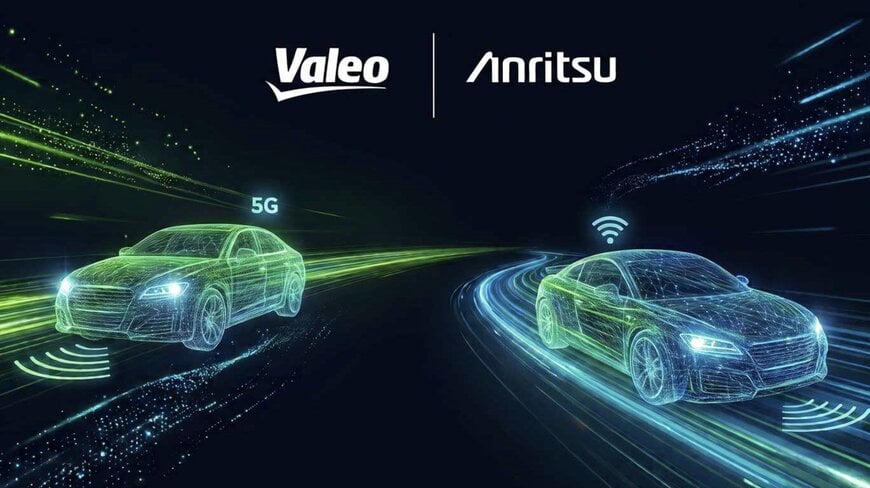
Valeo and Anritsu Corporation have collaborated to deploy a digital twin validation framework designed to test connected systems in software-defined vehicles within fully virtual environments. Presented at the 5G Automotive Association 39th Meeting held October 26 to 29, 2026, in New Delhi, India, the technical platform replaces physical track testing with software-in-the-loop simulation for critical in-vehicle communication protocols.
Validation Bottlenecks in Automotive Connectivity
The transition toward software-defined vehicle architectures integrates cellular vehicle-to-everything communication, over-the-air firmware distribution, and cloud telematics into core vehicular functions. Validating these dynamic communication pipelines under physical track conditions requires driving across varied cellular base stations, simulating multi-carrier network boundaries, and physically reproducing intermittent wireless signal dropouts. These track-based workflows are cost-prohibitive, challenging to reproduce deterministically, and difficult to scale across global carrier configurations. To address these limitations, Valeo and Anritsu established a modular software-in-the-loop validation pipeline that models RF propagation and vehicular computing nodes virtually.
System Architecture and Technical Responsibilities
The validation platform interfaces Valeo’s virtual electronic control unit simulation architecture with Anritsu’s cellular emulation software. Valeo supplies the virtualized automotive computing environments, replicating onboard telematics control units, host software stacks, and vehicle bus interactions. Anritsu provides the network emulation layer through a software-in-the-loop cellular tester that generates multi-carrier radio access network profiles.
At the functional layer, the unified digital twin models complex radio frequency phenomena, including inter-mobile network operator handovers, variable packet latency, jitter, Doppler shifts, and packet loss scenarios. Automakers deploy the joint software stack either in local hardware test benches or across scalable cloud instances. The virtual testing harness directly drives electronic control unit firmware with synthesized RF metadata, confirming transmission recovery, message prioritization, and data integrity under degraded network links.
Deployment Scenarios and Regulatory Verification
The system validates high-priority automotive safety and telemetry services without requiring prototype vehicles. A primary operational use case involves automated testing of regulatory Emergency Call workflows. The platform evaluates whether simulated telematics modules detect vehicle crash signals, initiate priority cellular connections across competing public land mobile networks, and transmit minimum set of data packets without timeout errors.
Additionally, the setup executes multi-vehicle vehicle-to-network scenarios, verifying that automated driving algorithms properly receive and process collective perception messages across changing base station handoffs.
Operational Impact and Test Efficiency
Migrating automotive wireless validation into a synchronized digital twin environment eliminates dependency on physical test tracks and specialized carrier drive-testing. Development teams run continuous automated regression tests against evolving firmware revisions, ensuring reliable over-the-air deployment while shortening development lifecycles and standardizing safety-critical telematics verification.
Edited by Romila DSilva, Induportals Editor, with AI assistance.
www.valeo.com
