
www.auto-innovations.net
13
'26
Written on Modified on
ZF Advances Technology-Open Solutions for Commercial Vehicle Decarbonization & Efficiency
Scalable hybrid, electric, braking, air management and software technologies help OEMs and fleets reduce emissions while balancing performance and costs.
www.zf.com
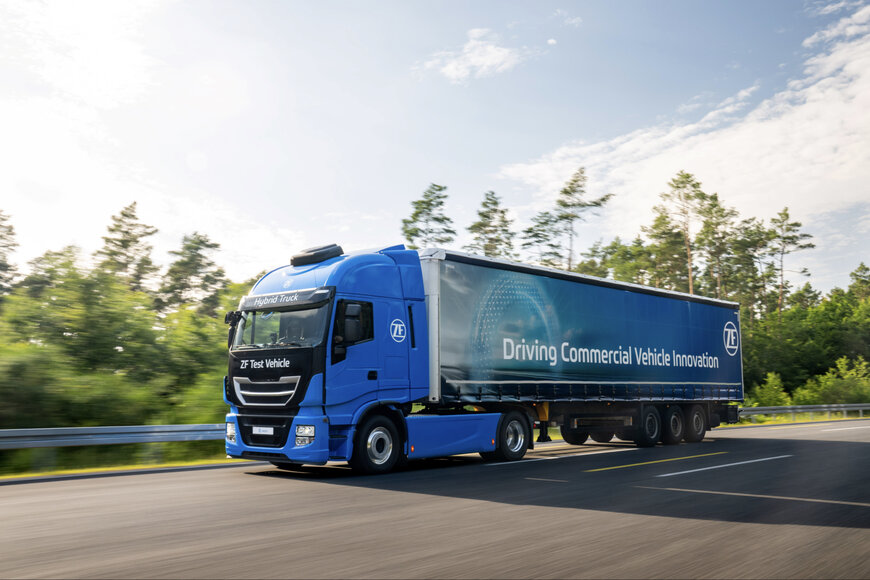
ZF Friedrichshafen AG has outlined a comprehensive strategy for commercial vehicle decarbonization through a scalable portfolio of hybrid and electric driveline systems. This technology-open approach allows original equipment manufacturers and fleet operators in the heavy-duty transport sector to transition to zero-emission operations based on regional infrastructure and duty-cycle demands.
Modular Hybrid Architectures for Heavy-Duty Applications
The transition to zero-emission transport requires flexible pathways for applications where fully electric infrastructure is not yet viable. The TraXon 2 Hybrid transmission facilitates a phased shift from conventional combustion engines to electrified powertrains. Engineered for heavy-duty commercial vehicles, the system integrates hybrid and electric driving modes to support regenerative braking and zero-emission operation in restricted urban zones. By building upon established transmission platforms and utilizing modular electric components, the hybrid configuration preserves the payload and range capabilities of conventional setups while demonstrably lowering fuel consumption and localized emissions. "Our technology-open portfolio enables OEMs and fleets to decarbonize step by step while maintaining operational performance," states Winfried Gründler, Head of Business Unit Driveline Solutions at ZF.
Central and Axle-Based Electric Driveline Systems
For applications suited to immediate electrification, ZF provides two distinct architectural approaches. The CeTrax 2 family of electric central drives serves as a direct replacement module within existing internal combustion engine vehicle platforms, packaging the electric motor into the traditional transmission space. Forthcoming iterations of this central drive will introduce higher power outputs, broader application coverage, and electronic Power Take-Off availability to support diverse vocational truck functions.
Simultaneously, the AxTrax 2 electric axle family integrates the electric motor and transmission directly into the axle housing, freeing up chassis space for larger battery enclosures in dedicated electric vehicle platforms. This system is expanding to support higher output torque specifications, accommodating increased gross combination weights for long-haul transport. Production of the AxTrax 2 has commenced in China, reflecting sustained international demand for integrated electric axle solutions in commercial transportation.
System Integration and Auxiliary Component Efficiency
Vehicle-level efficiency extends beyond primary propulsion systems to auxiliary management. Electrified trailer concepts integrate proprietary electric axles and braking systems, enabling trailers to contribute to overall vehicle propulsion and energy recuperation in active pilot projects. Additionally, the e-comp Scroll air compressor utilizes an oil-free mechanism to supply compressed air. This design reduces maintenance cycles, improves air purity, and minimizes acoustic emissions, which is critical for urban electric bus fleets.
Systemic integration is critical for maximizing these hardware capabilities. Advanced control algorithms synchronize the driveline, braking arrays, and thermal management systems to optimize energy consumption. "Further significant efficiency gains can be unlocked through the intelligent interaction of ZF systems across the vehicle, especially through the synergies between driveline and braking systems," notes Dr. Johannes Heseding, Manager of Innovation Electrification & Efficiency at ZF. This systemic integration unlocks efficiency gains that standalone components cannot replicate.
Adapting to Regulatory Standards and Market Demands
As environmental regulations such as the Euro 7 emissions standard take effect, commercial fleet operators require adaptable hardware to remain compliant while balancing the total cost of ownership. The scalable portfolio allows manufacturers to tailor vehicle specifications to precise regional timelines and operational profiles. ZF will present its commercial vehicle decarbonization technologies, including hybrid and electric driveline enhancements, at the upcoming IAA Transportation 2026 event in Hanover, Germany, located in Hall 21, Booth B42.
Additional Context:
This section details technical specifications and competitive benchmarking not included in the original product announcement
The TraXon 2 Hybrid system utilizes a 190 kilowatt oil-cooled permanent magnet synchronous hairpin electric motor paired with a silicon carbide inverter. This advanced inverter technology optimizes thermal management and electrical efficiency compared to traditional insulated-gate bipolar transistor inverters. In plug-in hybrid applications, this configuration can deliver fuel consumption and carbon dioxide emission reductions of up to 40 percent compared to conventional internal combustion drivetrains.
The CeTrax 2 dual motor variant achieves 380 kilowatts of continuous power. This provides a direct benchmark against similar heavy-duty traction motors from competitors such as Robert Bosch GmbH, which also aim for high continuous-to-peak power ratios to sustain heavy-duty performance on demanding routes. The AxTrax 2 electric axle platform delivers an estimated 20 percent reduction in energy consumption relative to earlier axle generations, establishing a quantifiable advantage over legacy transit axle technologies. When integrated into internal combustion engine truck-trailer configurations, the AxTrax 2 architecture functions as a hybrid system that yields 16 percent fuel savings in standard operation.
Edited by Natania Lyngdoh, Induportals editor, assisted by AI.
www.zf.com
