
www.auto-innovations.net
18
'26
Written on Modified on
ZF LIFETEC Links Occupant Sensing with Adaptive Airbag and Seat Belt Protection
Cameras and seat sensors identify occupant position, weight and size, enabling adaptive airbags and seat belts to tailor protection strategies to crash scenarios.
www.zf.com
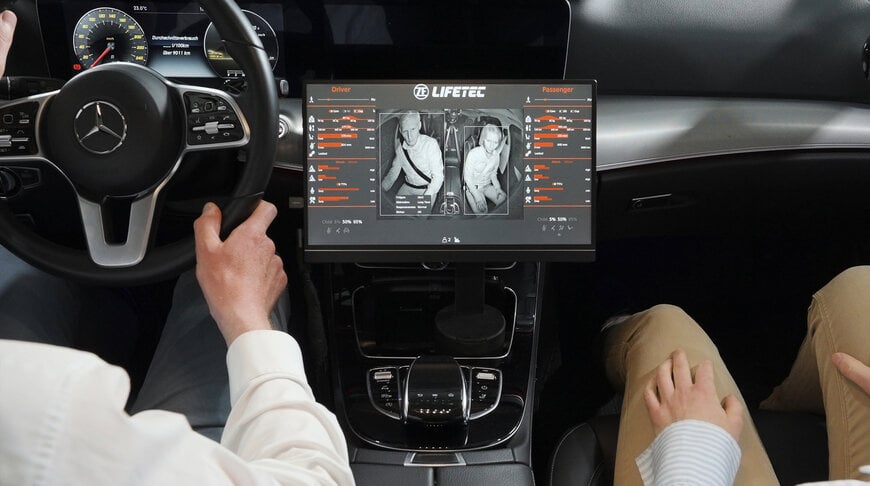
Automotive passive safety supplier ZF LIFETEC has introduced an integrated safety system that connects real-time occupant monitoring data directly to adaptive restraint deployment mechanisms. The technical architecture addresses passenger car manufacturing and automated driving platforms by tailoring airbag geometry, gas venting, and seat belt tensioning to individual occupant biometrics and seating postures.
Multi-Sensor Cabin Perception and Algorithm Integration
Passive safety protocols historically relied on external crash accelerometers and chassis deformation sensors to trigger restraint systems with predetermined pyrotechnic force curves. The ZF LIFETEC approach incorporates in-cabin perception hardware into the restraint control loop to dynamically adjust crash response parameters. Interior optical camera sensors, seat load cells, and seat belt latch and displacement sensors measure real-time occupant mass, physical dimensions, and operational posture.
Software algorithms process this continuous stream of sensor data to determine occupant classification and exact seating positioning relative to vehicle interior surfaces. Harald Lutz, Senior Vice President of Research and Development at ZF LIFETEC, states that interior sensors provide technical value by translating real-time cabin data directly into optimized restraint intervention. Philipp Russ, Head of Occupant Monitoring at ZF LIFETEC, notes that determining occupant identity, physical stature, and seated posture is as critical as evaluating crash angle and acceleration severity when calculating impact mitigation profiles.
Dynamic Actuation via Dual Contour Airbags and Motorized Retractors
The processing framework controls mechanical actuators engineered with variable operating profiles. Airbag hardware utilizes variable gas venting systems and adjustable chamber sizing to alter inflation characteristics based on measured crash metrics and occupant position. Dual Contour Airbags for the driver and front passenger adjust cushion volume dynamically to match distance variations caused by seat adjustment or reclined torso angles.
Complementing the airbag systems, motorized seat belt hardware from the ACR.8 active control retractor family applies multi-stage load limiting profiles. The retractor adjusts web tensioning force based on classified occupant mass, minimizing peak thoracic chest loads and reducing torso displacement during secondary impacts. This coordinated intervention between pyrotechnics and active seat belt motors prevents the application of uniform, excessive restraint forces on smaller occupants while delivering sufficient kinetic deceleration for larger occupants.
Regulatory Compliance and Exhibition Demonstration
The development aligns with evolving Euro NCAP assessment protocols extending through 2030, which mandate Occupant Status Monitoring, automated passenger airbag deactivation, seat belt utilization tracking, and anthropometric size classification. The system demonstrates compliance pathways for automotive original equipment manufacturers adapting vehicle cabins to automated driving architectures, where occupants adopt diverse recline and posture angles.
The production-ready architecture was presented inside a dedicated demonstration vehicle at the InCabin Europe 2026 conference and exhibition, held in Barcelona, Spain, from September 22 to 24, 2026. The exhibit illustrated the operational link between optical and physical sensor detection, control algorithm processing, and variable mechanical restraint activation across diverse occupant sizes and crash vectors.
Additional Context:
This section details technical specifications and competitive benchmarking not included in the original product announcement
The ZF LIFETEC active passive safety suite utilizes the ACR.8 active control retractor, which incorporates an integrated electric drive motor and pyrotechnic pretensioner. The unit generates pre-crash reversible tensioning forces of up to several hundred Newtons within 100 milliseconds to remove seat belt slack during rapid deceleration maneuvers, while subsequent pyrotechnic squibs activate millisecond-level locking during actual collision impacts. The Dual Contour Airbag operates multi-stage inflators and internal active tethers that vary deployed volume between approximately 60 liters and 90 liters depending on occupant standoff distance.
Within the automotive passive safety and restraint control sector, the primary benchmark competitor is Autoliv, which deploys adaptive restraint systems incorporating motorized seat belt pretensioners, such as the Motorized Seatbelt (MSB) system, alongside adaptive venting passenger airbags and smart seat belt buckles. Autoliv restraint architectures interface with third-party interior sensing systems—such as time-of-flight (ToF) cameras and radar modules from suppliers like Seeing Machines and Smart Eye—using separate electronic control units (ECUs) to adjust pyro-switchable load limiters.
While Autoliv typically relies on modular partnerships with standalone interior perception software providers to feed restraint control algorithms, ZF LIFETEC focuses on an integrated vertical hardware and software package linking proprietary cabin sensing feeds directly into the restraint deployment firing loop, reducing integration latency and calibration overhead for vehicle manufacturers targeting Euro NCAP 2026 five-star criteria.
Edited by Natania Lyngdoh, Induportals editor, assisted by AI.
www.zf.com
