
www.auto-innovations.net
17
'26
Written on Modified on
Hybrid transmission improves heavy-duty fleet efficiency
ZF Commercial Vehicle Solutions tests transmission to support automotive data ecosystem and EU decarbonization targets in long-haul and distribution transport.
www.zf.com
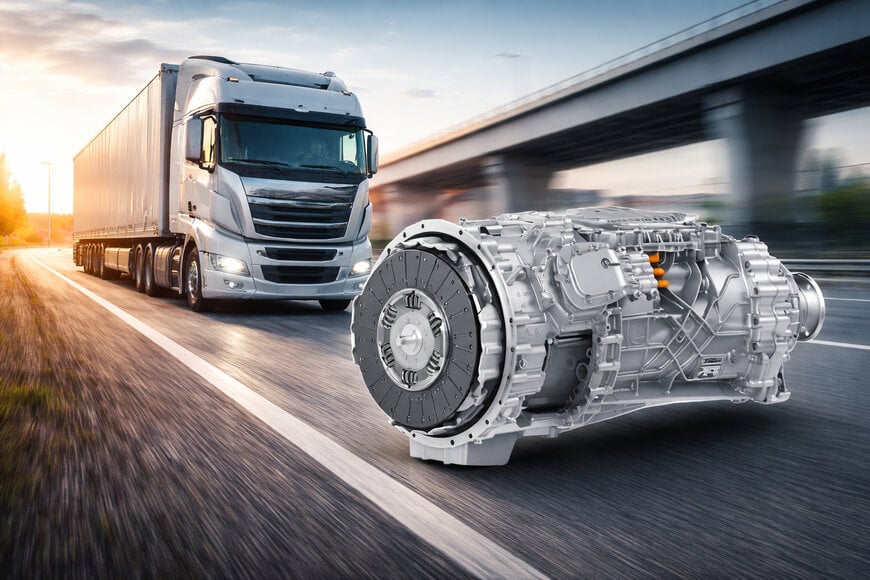
A hybrid transmission system for heavy commercial vehicles has been validated under controlled and real-world testing conditions, demonstrating measurable CO₂ reduction potential while maintaining operational flexibility for logistics fleets.
Validation under operational conditions
ZF Commercial Vehicle Solutions conducted a dedicated test programme at its Friedrichshafen facility in Germany, where international media evaluated the performance of its next-generation hybrid transmission. The trials focused on practical deployment scenarios, reflecting the constraints of long-haul and regional freight operations.
The system addresses a key limitation in heavy-duty transport: the difficulty of achieving full electrification across variable routes and infrastructure conditions. Hybridisation enables partial electrification without compromising range or payload capacity.
Quantified emissions reduction and cost efficiency
Testing based on VECTO-aligned simulations indicates that the plug-in hybrid system can reduce CO₂ emissions by up to 47% in long-haul applications and up to 73% in distribution transport, provided that vehicles are regularly recharged. These values position the system within the requirements of 2030 European fleet emission targets.
From an operational perspective, the combination of reduced fuel consumption and electric driving capability contributes to cost efficiency. ZF estimates that, under typical usage conditions, the additional system cost can be recovered in less than two years compared with conventional diesel drivetrains.
Hybrid architecture and drivetrain integration
The system builds on the TraXon 2 transmission platform and integrates an in-house developed electric motor in a P2 configuration between the clutch and transmission. This configuration enables electric-only driving, particularly in low-emission zones, while also supporting hybrid operation across the full gear range.
Operating at 600 to 800 volts, the electric motor delivers 190 kW of continuous power, with higher peak output available for acceleration and load handling. Regenerative braking further improves efficiency by recovering energy during deceleration. The combustion engine remains available for long-distance operation, ensuring that range and refuelling flexibility are preserved.
Compatibility with diverse energy strategies
The hybrid transmission is designed as a modular solution within a broader electrification portfolio. It can be combined with conventional diesel engines as well as alternative fuels such as HVO or e-fuels, CNG/LPG, and hydrogen combustion engines.
It also complements ZF’s existing electric drivetrain technologies, including CeTrax 2 and AxTrax 2, enabling fleet operators to align vehicle configurations with infrastructure availability and long-term decarbonisation strategies.
Role in the transition to low-emission logistics
Hybrid systems of this type provide a transitional solution for fleets that cannot fully electrify due to operational or financial constraints. They allow a gradual shift toward electrified transport while maintaining compatibility with existing logistics models.
At the same time, such systems contribute to a connected automotive data ecosystem, where operational data from hybrid drivetrains can be used to optimise routing, charging strategies, and energy consumption. This integration of hardware and data is increasingly central to improving efficiency in heavy-duty transport.
Edited by an industrial journalist Sucithra Mani with AI assistance.
www.zf.com
