
www.auto-innovations.net
08
'26
Written on Modified on
Scalable ADAS Platform for Software-Defined Vehicles
ZF and Qualcomm Technologies combine automotive computing and AI perception to deliver a modular, high-performance ADAS platform based on centralized vehicle architectures.
www.zf.com
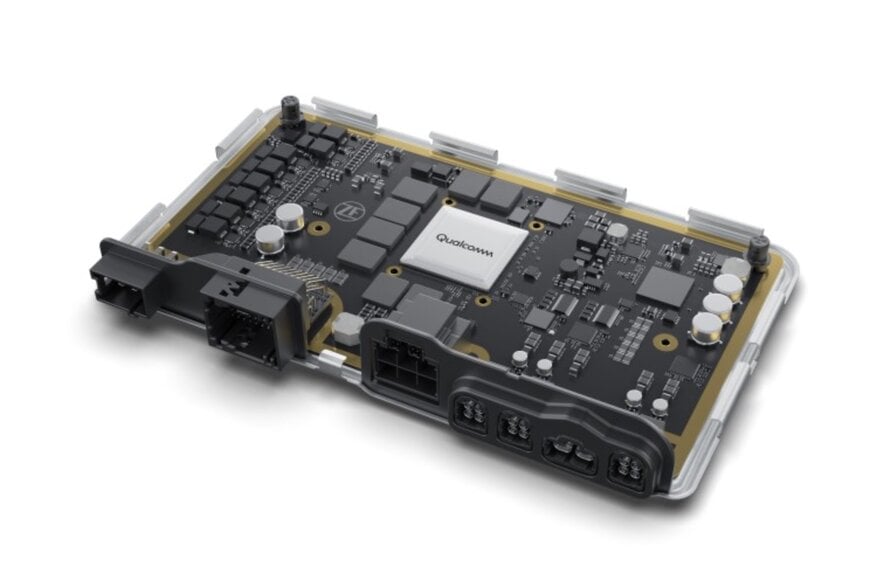
As vehicle architectures shift toward software-defined and centralized compute models, ZF and Qualcomm Technologies have announced a technology collaboration to deliver a scalable advanced driver assistance system (ADAS) platform. The joint solution integrates Qualcomm’s Snapdragon Ride system-on-chips (SoCs) with ZF’s ProAI automotive supercomputer, targeting automated driving functions ranging from regulatory safety features up to Level 3 automation.
Centralized compute for ADAS scalability
Modern ADAS development is increasingly constrained by fragmented electronic control unit (ECU) architectures, which add cost, complexity, and latency. The ZF–Qualcomm collaboration addresses this by enabling a centralized or zonal compute approach, where perception, sensor fusion, and control logic can run on a shared high-performance platform.
At the core is ZF’s ProAI family, an automotive-grade central computer designed to support multiple vehicle platforms and end-to-end (E2E) AI architectures. In its highest configuration, ProAI offers more than 1,500 TOPS of compute performance using multiple performance boards, allowing it to act as a domain controller, zonal controller, or central vehicle computer depending on OEM requirements.
Snapdragon Ride as the AI and perception foundation
Qualcomm’s Snapdragon Ride SoCs provide the AI acceleration and real-time processing needed for perception-heavy ADAS workloads. Within the collaboration, ProAI integrates the Snapdragon Ride Pilot and Vision stack, enabling camera-based AI perception for object detection, lane and traffic sign recognition, parking assistance, driver monitoring, and real-time mapping.
System configurations scale from a single forward-facing camera to multi-camera surround perception. Performance is enhanced through a bird’s-eye-view (BEV) architecture, advanced fisheye camera processing, and radar integration to reduce latency and improve robustness in complex traffic scenarios. Hardware–software co-design and network optimization are used to manage compute resources efficiently under real-time constraints.
Modular ADAS functions and open integration
ZF contributes a portfolio of approximately 25 ADAS functions covering safety, comfort, and parking use cases. These include advanced features such as hands-off Navigate on Autopilot (NOA). OEMs can select and combine functions from this pool on a modular basis, either as integrated systems or as stand-alone software-as-a-product, supporting flexible vehicle differentiation.
The platform is built on Qualcomm Technologies’ open integration architecture, which uses standardized interfaces and abstraction layers to support third-party software integration. This design allows dynamic allocation of compute resources across heterogeneous ECUs and supports over-the-air (OTA) updates, enabling feature upgrades and lifecycle extension without hardware changes.
Development toolchain and time-to-market impact
A shared development toolchain underpins the collaboration, providing simulation environments, software frameworks, and APIs optimized for the Snapdragon Ride platform. This toolchain is intended to accelerate prototyping, validation, and deployment of ADAS and infotainment functions, while supporting collaboration across hardware and software teams.
By combining high-performance centralized compute with a modular software approach, the ZF–Qualcomm solution is positioned to reduce integration effort and shorten time-to-market for automated driving functions. The collaboration reflects broader industry trends toward centralized vehicle computers and AI-driven perception as foundational elements of next-generation ADAS and automated driving systems.
www.zf.com
