
www.auto-innovations.net
07
'26
Written on Modified on
ZF Debuts AI-Driven Chassis Intelligence and Noise Control at CES 2026
ZF showcased predictive chassis software and acoustic control technologies enabling software-defined vehicles to adapt dynamically to road conditions and driving behavior.
www.zf.com
As vehicles transition toward software-defined architectures, the chassis is no longer a passive mechanical system but an active, software-controlled platform. ZF’s latest developments reflect this shift by embedding artificial intelligence and real-time software control directly into chassis functions, enabling vehicles to adapt continuously to road conditions, driver behavior and acoustic environments.
Presented at CES 2026 (January 6–9, 2026, in Las Vegas, Nevada), ZF’s new chassis software portfolio forms part of its “Chassis 2.0” strategy, which integrates smart actuators, AI-based sensing and centralized software control to support future vehicle platforms.
AI Road Sense for predictive chassis adaptation
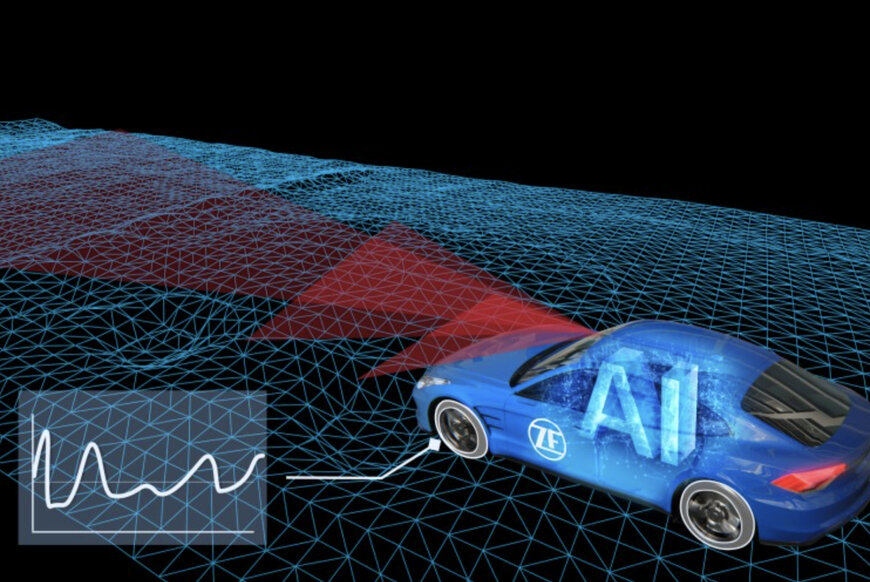
AI Road Sense is a software-based system designed to detect road surface conditions and driving situations in real time, then proactively adjust chassis behavior. The system processes input from multiple vehicle sensors and uses ZF’s cubiX chassis software to coordinate actuators such as semi-active dampers and fully active suspension systems.
In its basic configuration, AI Road Sense analyzes CAN bus signals to infer road conditions. More advanced versions incorporate camera data for predictive surface recognition, while the premium configuration adds LiDAR sensing to scan the road profile up to 25 meters ahead with centimeter-level resolution. This enables the chassis to prepare for upcoming surface changes before the vehicle encounters them.
By combining sensor data with vehicle dynamics signals such as wheel slip and torque variation, the system distinguishes between different surface states, including deep versus compacted snow, loose gravel, mud or asphalt transitions. Chassis settings are adjusted automatically without requiring driver input, supporting consistent vehicle behavior across changing environments.
Integration with by-wire and active damping systems
AI Road Sense is designed to operate within ZF’s broader by-wire ecosystem. It interfaces with semi-active Continuous Damping Control (CDC) systems and the fully active sMOTION suspension, which can react to control inputs within milliseconds. Future configurations are intended to integrate steering-by-wire and brake-by-wire functions, extending predictive control beyond suspension to longitudinal and lateral vehicle dynamics.
The software also supports driver behavior recognition by analyzing throttle, braking and steering inputs. This allows the chassis to adapt not only to external conditions but also to individual driving styles, enabling differentiated vehicle tuning without mechanical changes.
Software-based reduction of tire noise
Alongside AI Road Sense, ZF introduced Active Noise Reduction software aimed at reducing tire cavity noise transmitted into the vehicle interior. Rather than relying on additional insulation or acoustic materials, the system uses existing chassis sensors and semi-active dampers to counteract vibration-induced noise through software control.
The system is managed through ZF’s cubiX software and uses real-time vibration data to generate counteracting forces within the suspension. Current implementations achieve noise reductions of up to 3 dB, with further reductions projected as algorithms and actuator integration evolve. Series production is planned from 2028, with applicability across multiple vehicle segments.
Chassis software as a core SDV function
By consolidating sensing, control and actuation within a unified software framework, ZF positions the chassis as a programmable system that can be updated, personalized and optimized over the vehicle lifecycle. This approach reduces reliance on fixed mechanical tuning and enables faster adaptation to new vehicle architectures, including electric and autonomous platforms.
With AI Road Sense and Active Noise Reduction, ZF demonstrates how chassis functions can contribute directly to safety, comfort and brand differentiation in software-defined vehicles—extending digital control beyond infotainment and powertrain systems into the physical dynamics of driving itself.
www.zf.com
