
www.auto-innovations.net
18
'25
Written on Modified on
ZF Reveals New Software Driven Active Noise Reduction
ZF’s software-based technology uses dampers to reduce noise by 3-10 dB, bringing premium acoustic comfort to affordable vehicle segments without requiring any additional hardware.
www.zf.com
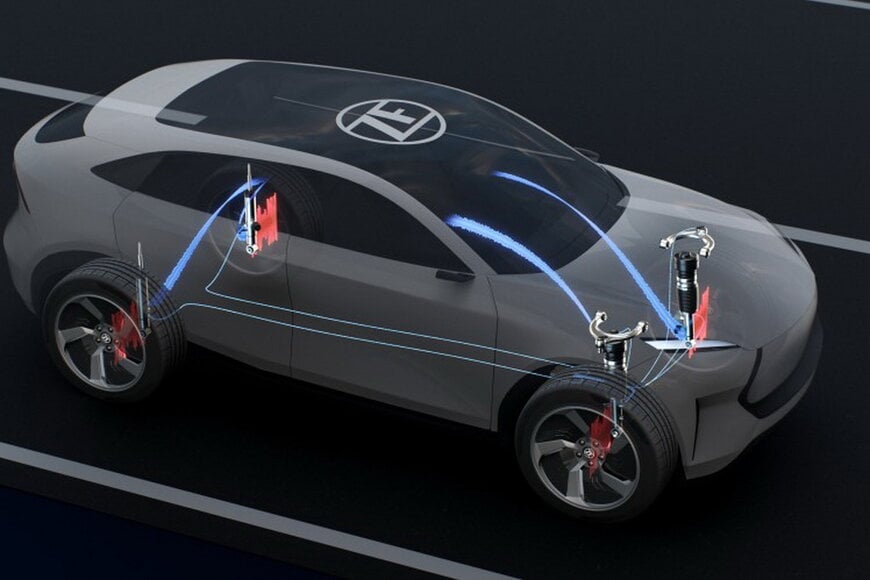
ZF Group has introduced an Active Noise Reduction (ANR) function integrated into vehicle chassis systems at CES 2026 in Las Vegas, positioning the technology for use in sectors such as passenger cars and commercial vehicles where chassis-borne noise control affects cabin comfort and system performance. The announcement underscores the company’s broader advancement of electrical and software-oriented architectures in modern vehicles.
Technology Context and Relevance
The ANR function represents a tactical extension of chassis control toward managing vibrational and acoustic dynamics via software-driven actuators. Traditional chassis components address ride and handling through mechanical damping and structural design; the ANR system augments these with dynamic input based on real-time sensor feedback to counteract undesired noise and vibration. This approach aligns with broader trends in vehicle electrical architectures that integrate digital signal processing and real-time control loops, similar in spirit to advances in digital supply chain and vehicle data ecosystems, where sensor data informs system actions.
Technical Basis of the ANR Function
Active noise reduction systems combine sensor inputs with control algorithms to generate counteracting forces or signals that diminish specific frequency bands of noise or vibration within a system. In automotive chassis applications, this can involve electromechanical actuators or suspension modulation elements that respond to measured accelerations, road inputs, and engine-induced vibrations. The goal in these systems is to achieve targeted reductions in transmitted power to the cabin at critical frequencies without degrading handling or stability. The use of software and actuator networks enables finer control and faster response than purely passive mechanical designs.
Integration into Vehicle Electrical Systems
Vehicles with increasing levels of software-defined functions rely on robust internal data networks to support real-time control tasks. ZF’s work on high-bandwidth electrical networks, such as optical multi-gigabit Ethernet leveraging IEEE 802.3cz-2023 for in-vehicle data transfer, illustrates the parallel evolution of vehicle electrical backbones to support complex functions including advanced driver assistance, infotainment and now active chassis control. Optical multi-gigabit Ethernet systems support data rates from 2.5 Gbit/s to 50 Gbit/s over distances up to 40 meters, decreasing weight and electromagnetic interference compared with copper cabling and aligning with the connectivity needs of such real-time systems in software-defined vehicles.
Application Areas and Use Cases
The primary application of ANR in chassis systems is in passenger and commercial vehicles where interior acoustic comfort is a differentiating factor. Beyond comfort, controlling vibrational energy has implications for sensor performance and durability of structural components in vehicles with high levels of electronics and sensitive sensor suites. In electric vehicles (EVs) and hybrid vehicles, where low powertrain noise exposes other noise sources, active noise strategies in the chassis can improve perceived quietness that passive engineering alone cannot achieve.
Benefits and Technical Outcomes
Integrating active noise reduction at the chassis level can deliver quantifiable improvements in cabin noise levels, typically measured in decibels (dB) at specific frequency bands relevant to human perception. By reducing structural and road-induced noise, the system can enhance occupant comfort and decrease driver fatigue, while its software basis enables calibration tailored to vehicle type, speed range, and road conditions. Software-driven chassis functions also facilitate updates over the air and integration with other vehicle control domains.
Competitive and Industry Context
Active noise cancellation in vehicles is not new in the audio domain; it has been applied in speaker-based cabin noise cancellation systems. However, extending these principles into chassis control represents an architectural shift that integrates mechanical and electrical domains with real-time computing. Comparable technologies exist in high-end suspension and active damping systems from other suppliers, often focusing on ride and handling; ZF’s ANR function situates itself specifically at the intersection of chassis control and acoustic management, enabled by advanced data networks and control software that are emerging as benchmarks for next-generation vehicle electrical and control ecosystems.
As vehicle architectures evolve toward software-defined platforms with high-speed data networks and tightly integrated control systems, chassis-level active noise reduction exemplifies how mechanical functions are being augmented or partly redefined by software and sensor networks. The ANR system presented by ZF at CES 2026 builds on these trends, offering a technically grounded solution aimed at controlling noise and vibration in diverse vehicle segments while leveraging advances in connected vehicle infrastructures such as optical multi-gigabit Ethernet that underpin modern electrical systems.
www.zf.com
