
www.auto-innovations.net
03
'25
Written on Modified on
Hella and Tau Motors Partner for Charging Solutions
The viOBC from FORVIA HELLA and Tau Motors eliminates the need for a transformer, reducing its size by half and weight by a third, while increasing power density.
www.forvia.com
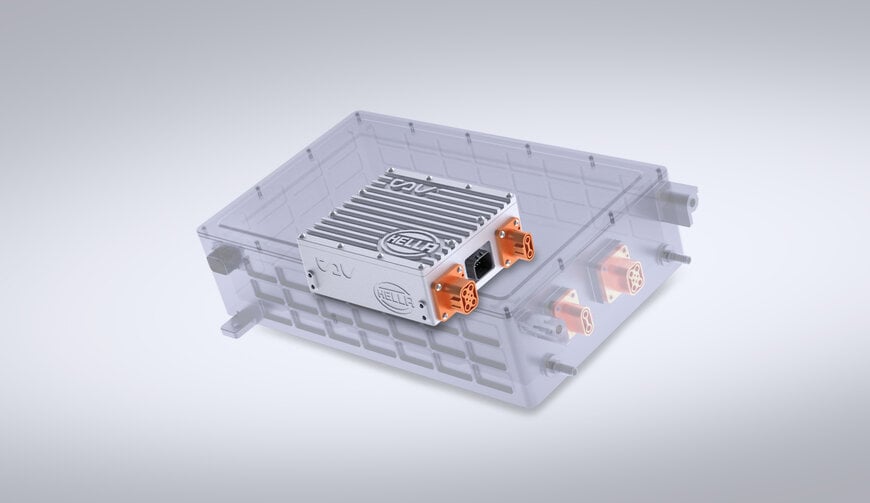
International automotive supplier FORVIA HELLA and Tau Motors, a pioneer in software-defined power conversion, are working on advanced charging solutions in the context of a strategic development cooperation. The focus is on the development of a "virtually isolated Onboard Charger (viOBC)" for electric vehicles, aiming to bring it into series production within the next two to three years. By dispensing with a transformer, the viOBC has a high power density and energy efficiency on the one hand; on the other, the weight and required installation space can be significantly reduced. The product also enables advanced energy management in vehicles, including vehicle-to-grid integration with bidirectional charging. The development partnership also includes an investment in Tau via the venture capital arm HELLA Ventures.
In this partnership, FORVIA HELLA contributes extensive expertise in the field of high-voltage and power electronics as well as industrialization capabilities. Tau brings its software-defined technology platform alongside deep expertise in power electronics, controls, and innovative product design capability to the table.
Compared to conventional charging solutions, the virtually isolated Onboard Charger requires no transformer for galvanic separation (isolation) between the AC grid and the DC vehicle system thanks to innovative software and hardware design. Despite this, it fully ensures electrical and functional safety while maintaining the range of functions found in transformer-based designs. By eliminating the transformer, the viOBC achieves a very high power density of up to 7 kW per liter of installation volume. The virtual isolation technology enables the space requirements and volume for vehicle’s OBC to be reduced by up to half, and its weight by around a third.
Moreover, the transformerless design enables an energy efficiency of more than 98 percent during the charging process. This subsequently enables CO2 savings through weight reduction as well as lower electricity costs due to higher efficiency. A viOBC prototype has now successfully completed its technological and commercial concept testing; series production is expected to begin within the next two to three years.
www.hella.com
In this partnership, FORVIA HELLA contributes extensive expertise in the field of high-voltage and power electronics as well as industrialization capabilities. Tau brings its software-defined technology platform alongside deep expertise in power electronics, controls, and innovative product design capability to the table.
Compared to conventional charging solutions, the virtually isolated Onboard Charger requires no transformer for galvanic separation (isolation) between the AC grid and the DC vehicle system thanks to innovative software and hardware design. Despite this, it fully ensures electrical and functional safety while maintaining the range of functions found in transformer-based designs. By eliminating the transformer, the viOBC achieves a very high power density of up to 7 kW per liter of installation volume. The virtual isolation technology enables the space requirements and volume for vehicle’s OBC to be reduced by up to half, and its weight by around a third.
Moreover, the transformerless design enables an energy efficiency of more than 98 percent during the charging process. This subsequently enables CO2 savings through weight reduction as well as lower electricity costs due to higher efficiency. A viOBC prototype has now successfully completed its technological and commercial concept testing; series production is expected to begin within the next two to three years.
www.hella.com
