
www.auto-innovations.net
29
'24
Written on Modified on
A6 Sportback e-tron: The most aerodynamic Audi of all time
Progressive wheel designs: Wheel designer Andreas Valencia Pollex: “The wheel range for the A6 e-tron has been designed for maximum aerodynamics.”.
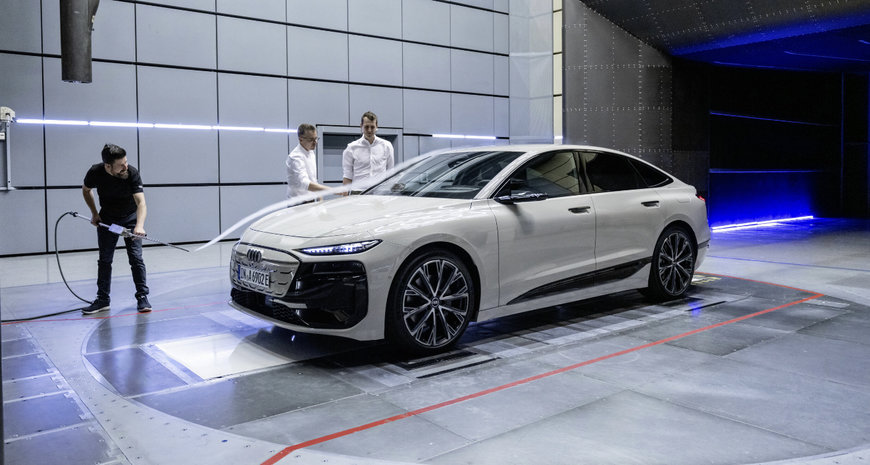
With an exceptionally low Cd value of 0.21, the Audi A6 Sportback e-tron1 is the most aerodynamic Audi of all time and leads the entire VW Group in its segment in terms of aerodynamics. The A6 Avant e-tron2 also achieves an excellent Cd value of 0.24, placing it at the top of its body segment. Aerodynamics developers Andreas Lauterbach and Matteo Ghelfi and wheel designer Andreas Valencia Pollex explain how they achieved the record value with meticulous attention to detail.
Aerodynamics has always played a key role in Audi’s long history of success. As far back as 1967, the NSU Ro 80 had an aerodynamic, wedge-shaped body with a Cd value of 0.35 that changed automotive design forever. The third-generation Audi 100 (C3), introduced in the summer of 1983, boasted a Cd value of 0.30, which was exceptional for its time. Right on its heels, the third-generation Audi 80 (B3) continued this success story with a drag value of 0.29. Now, the Audi A6 e-tron is writing a new chapter, proving once again that Audi always combines form and function in a perfect symbiosis.
The outstanding result was achieved primarily through “excellent teamwork between us (Aerodynamics experts) and our colleagues in Design. We all pulled together. From the beginning of the project, the Designers shared their drafts with us so that we could provide initial aerodynamic evaluations. In an iterative process – firstly using virtual simulations and later the physical model in the wind tunnel – we went on to optimize the basic vehicle body. In particular, the basic proportions with the slim greenhouse and the sloping roofline contribute to good aerodynamics.”
Lauterbach and Ghelfi devoted considerable time to working on the details with their colleagues in the Design team. Ghelfi: “In all, we ran over 1,300 simulations on the car and spent countless hours in the wind tunnel and in meetings collaborating with surface experts and designers. For example, air curtains are used to improve the airflow around the front of the car. The outside edge of the air curtain intake protruded somewhat, which impeded the airflow. Millimeter by millimeter, we reached a compromise that ultimately worked out for both sides.” Lauterbach adds: “Another example is the rear track width. Our team would have liked it to be narrower. Together, we found a solution that brought out the best in terms of design, dimensions, and aerodynamics.” Ghelfi: “Regarding aerodynamics, the aero bezels were particularly important. The lateral breakaway edges on the rear of the A6 Avant e-tron2 made it possible to achieve a clearly defined flow stall. They are significantly larger than in other Audi cars. Working in the wind tunnel with our Design colleagues, we carefully pored over each side's respective arguments and strived to find the best solution. The result is that the aero bezels alone improve the range by 0.008, equivalent to eight kilometers. That’s a significant advantage to come from a single design detail.”
www.audi.com
