
www.auto-innovations.net
06
'26
Written on Modified on
Automotive Interior LED Driver for Animated Lighting
Melexis introduced the MLX81132 programmable 24-channel LED driver IC to resolve escalating architectural complexity and bill-of-materials costs in automotive dynamic cabin illumination.
www.melexis.com
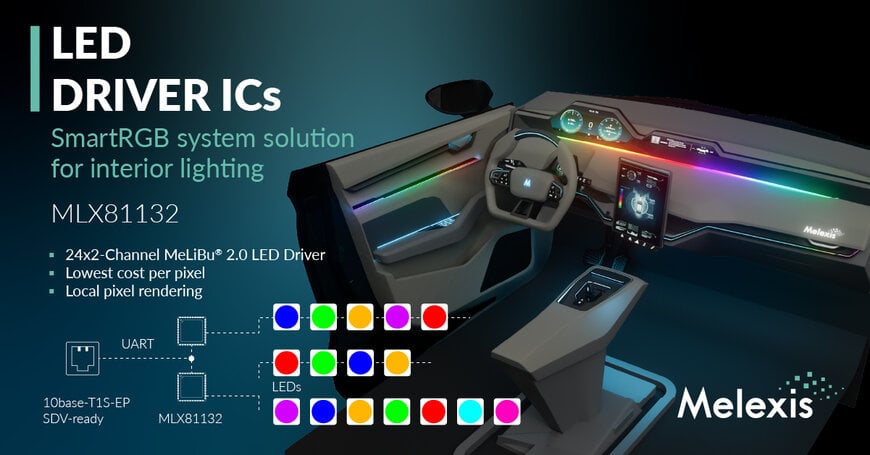
Cabin illumination in modern passenger vehicles is transitioning rapidly from static background lighting into dynamic functional interfaces that convey safety warnings, driver-assist cues, and interactive feedback across instrument panels, doors, and center consoles. Managing these dynamic features requires high-pixel-count animated interior lighting, pushing vehicle LED counts from dozens to well over one thousand distinct emitters. Traditional smart LED topologies, which integrate dedicated silicon controllers into every individual package, scale costs linearly with emitter count and create severe communication bottlenecks over daisy-chained lines. Engineering teams designing software-defined vehicle architectures face escalating silicon overhead, excessive thermal dissipation within tight trim spaces, and communication latency when coordinating synchronous light updates across cabin zones.
Multiplexed Silicon Control to Minimize Bill of Materials
Addressing the cost-per-pixel barrier in high-density installations, the Melexis MLX81132 concentrates driver intelligence and drive stages into a centralized multichannel IC rather than distributing active silicon to each optical point. Operating from a 5 V supply, the device integrates 24 constant-current LED output stages. Through onboard 2x multiplexing, a single integrated circuit directly modulates up to 48 discrete single-color LEDs or 16 RGB pixels.
Each channel provides a configurable drive current up to 80 mA, featuring channel-bundling capability to support higher peak currents when illuminating high-luminance optical light guides or indicators. Color mixing and smooth dimming transitions are driven by 16-bit pulse-width modulation control per channel, eliminating visible stepping during low-intensity operational cycles. By consolidating multiple optical outputs onto discrete passive LEDs, tier-1 suppliers achieve lower bill-of-materials expenses and maintain freedom to source standard discrete LEDs from various diode manufacturers.
Decentralized Processing and Functional Diagnostics
To mitigate the computational load placed on domain or zonal controllers, the MLX81132 integrates an embedded 16-bit programmable microcontroller core supported by 64 KB of Flash memory and 8 KB of RAM. This edge-processing architecture allows lighting engineers to execute color-coordinate mixing algorithms, ambient temperature compensation curves, and autonomous animation routines directly adjacent to the diodes.
System health and optical uniformity are monitored via an integrated 12-bit differential analog-to-digital converter. The device conducts real-time parametric diagnostics across all connected lines, detecting open-load conditions, output pin short-circuits, and local temperature spikes. Storing diode binning and optical calibration parameters directly within onboard non-volatile memory ensures consistent chromaticity across adjacent cabin sections over the complete automotive operational lifespan.
Bus Topology for Zonal Vehicle Architecture Integration
The device utilizes the MeLiBu 2.0 communication protocol, supporting configurable differential transmission rates up to 4 Mbit/s alongside 10BASE-T1S-Endpoint connectivity. Unlike sequential serial daisy-chain topologies where a single failed node breaks downstream communication, this bus-oriented protocol provides individual device addressing and deterministic, synchronous updates across distributed physical segments.
Physical lighting installations split across segmented door cards, console sections, and headliner modules are synchronized via bus extension interfaces. Peripheral sensors and secondary drivers interface directly through onboard SPI and I2C buses. Developed under ISO 26262 engineering guidelines to support system designs up to ASIL B, the component features configurable hardware fail-safe routines, making it suitable for safety-relevant driver warning indicators, contour lighting strips, and waterfall lighting displays.
"Animated lighting is now a vehicle-wide interface, but increasing the number of pixels can quickly increase both system cost and architectural complexity," stated Michael Bender, Product Line Director at Melexis. "With the MLX81132, we are putting sophisticated LED control capability behind multiple pixels rather than replicating driver intelligence at every light point. This gives customers a highly flexible foundation for comprehensive interior lighting across the vehicle while significantly lowering the total bill of materials."
The MLX81132 represents the initial member of Melexis's next-generation MeLiBu platform, with follow-on variants planned for code-free operation and exterior dynamic signal lighting.
Additional Context
This section details technical specifications and competitive benchmarking not included in the original product announcement.
The migration toward zonal electrical/electronic architectures and high-density interior lighting has accelerated the competitive division between two architectural philosophies: distributed intelligent LEDs and centralized multi-channel matrix drivers.
In distributed smart LED networks — such as those based on the Open ISELED standard — each RGB package integrates a driver ASIC communicating serially via a differential daisy-chain protocol at speeds typically up to 2 Mbit/s. While ISELED reduces external board routing by embedding calibration and drivers inside every LED package, it enforces proprietary LED packaging sourcing and scales silicon costs proportionally with every added pixel. In contrast, Melexis's MeLiBu architecture pairs a multi-channel driver with standard discrete LEDs. Operating at 4 Mbit/s, MeLiBu 2.0 doubles the raw communication bandwidth over classic ISELED implementations, enabling higher animation frame rates across dense pixel arrays. Furthermore, incorporating 10BASE-T1S endpoint support aligns the driver directly with IEEE 802.3cg automotive Ethernet standards, allowing direct integration into emerging automotive Ethernet-to-edge cabin zones without complex protocol-translating gateways.
Comparable multichannel matrix lighting solutions from semiconductor manufacturers such as Texas Instruments (e.g., the LP886x series) and STMicroelectronics typically rely on standard Automotive SPI, CAN FD, or LIN bus transceivers. While LIN is bandwidth-constrained to 20 kbit/s — making it unsuitable for multi-pixel animated sequences — CAN FD and SPI require substantial board space and microcontroller overhead to manage synchronous refresh rates across hundreds of distributed nodes. The MLX81132 bridges this gap by integrating an ASIL B-capable processing core with a 4 Mbit/s dedicated differential bus, positioning the component between slow standard sub-buses and high-cost distributed smart-diode hardware.
Edited by Evgeny Churilov, Induportals Media - Adapted by AI.
www.melexis.com
