
www.auto-innovations.net
22
'26
Written on Modified on
NVIDIA Hyperion powers European automakers’ autonomous vehicles & future robotaxi fleets
Bolt, Lucid, Mercedes-Benz, Volkswagen, Einride and Volvo Cars adopt NVIDIA technologies for autonomous driving, while new tools strengthen safety validation and development.
www.nvidia.com
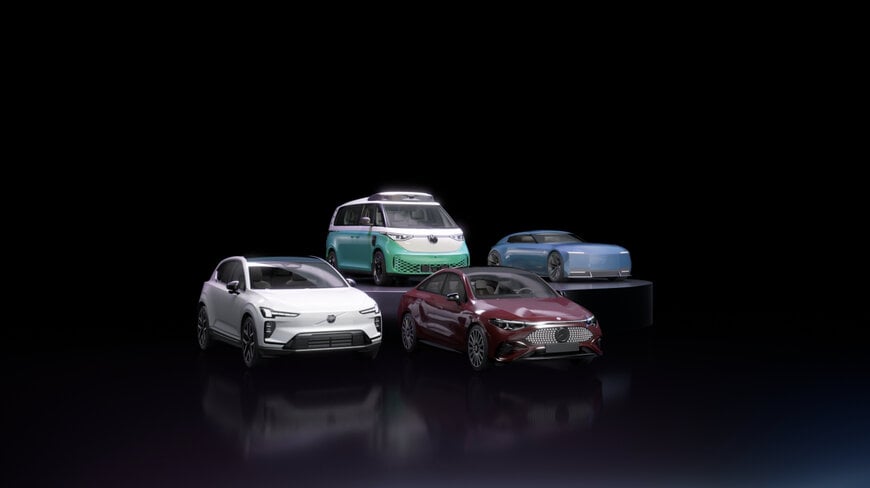
Autonomous vehicle engineering requires computing platforms capable of processing dense multi-sensor data streams in real time while maintaining strict functional safety compliance across diverse operating conditions. Standardizing high-performance automotive compute and deterministic safety validation remains a critical bottleneck for scaling commercial robotaxi operations and commercial transport.
At GTC Berlin, NVIDIA announced extended European deployments of its NVIDIA Hyperion autonomous driving platform, alongside the introduction of the Halos SAFE validation framework and new edge reasoning models under the Alpamayo family. Through collaborations spanning passenger cars, robotaxi fleets, and autonomous commercial freight, European manufacturers and mobility operators are using these integrated hardware and software architectures to transition automated driving systems from testing phases into commercial deployment.
Modular Architecture for Multi-Class Vehicle Automation
Developing Level 3 conditional automation and Level 4 high automation demands heterogeneous computing architectures capable of running deep neural networks alongside classical deterministic control loops. NVIDIA Hyperion functions as an open, modular reference architecture that pairs central in-vehicle computing hardware with a verified sensor topology, allowing automotive developers to run the turnkey NVIDIA Alpamayo Stack or integrate proprietary autonomous driving software.
European operators are deploying this architecture across multiple vehicle segments:
Bolt selected the NVIDIA Alpamayo Stack for its European robotaxi deployment program, beginning integration with Level 4-capable Lucid vehicles built on Hyperion. The company plans to collect real-world validation data in Madrid starting in 2027, with subsequent deployment in Germany targeting a fleet of at least 25,000 Level 4 vehicles.
Volvo Cars is integrating Hyperion hardware, Halos operating software, and the Alpamayo Stack into future production passenger models to support end-to-end automated driving.
Mercedes-Benz expanded its engineering engagement with NVIDIA on Hyperion and the Alpamayo Stack to advance Level 3 and Level 4 capabilities. The automaker confirmed that its co-developed MB.DRIVE ASSIST PRO platform is positioned for regulatory approval in Germany for point-to-point urban automated driver assistance.
Volkswagen Commercial Vehicles demonstrated the autonomous ID. Buzz AD vehicle platform using Hyperion to support multi-vendor autonomous software integration for robotaxi and shared transport fleets.
Einride is building its next-generation Einride Driver system on Hyperion to operate autonomous freight trucks, using Halos, Alpamayo, and NVIDIA Cosmos open world models for simulation and on-road verification.
TIER IV and the Technical University of Munich plan to evaluate Hyperion-based control architectures for automated municipal public transport networks in Germany.
Tier-1 automotive suppliers Aptiv, Valeo, and Schaeffler are developing production computing units based on Hyperion specifications to provide automotive manufacturers with pre-validated Level 4 hardware stacks.
Safety Verification Framework for Autonomous Driving Evaluation
Safety certification of machine-learned perception and planning models requires auditable testing that correlates virtual simulations with physical on-road behavior. NVIDIA introduced Halos SAFE, a Safety Assurance Framework for Evaluation within the NVIDIA Halos vehicle safety system, designed to generate traceable safety evidence across the automated driving lifecycle.
Developed in collaboration with testing organizations dSPACE, IVEX, and TÜV Rheinland, Halos SAFE unifies virtual simulation, software-in-the-loop (SIL), hardware-in-the-loop (HIL), track testing, and real-world fleet telemetry. The framework defines structured test scenarios and quantitative pass-fail metrics to confirm that physical AI systems comply with international safety criteria. Industry participants adopting the Halos SAFE ecosystem include Jaguar Land Rover (JLR), Mercedes-Benz, Volvo Cars, 51Sim, aiMotive, AVL, Deepen AI, Foretellix, and Synopsys.
On-Vehicle Edge Reasoning and Synthetic Data Workflows
Real-time autonomous trajectory generation in complex urban operational design domains requires low-latency inference architectures. NVIDIA detailed several AI models and development tools designed to accelerate physical deployment:
- Alpamayo 2 Edge: A 2-billion-parameter reasoning model built on NVIDIA Cosmos and optimized for the NVIDIA DRIVE AGX Thor in-vehicle system-on-chip. The model executes at an operating frequency of 10 Hz to provide low-latency edge reasoning, multi-modal scene understanding, and motion planning.
- AlpaJudge: A human-calibrated evaluation model that automatically rates driving logic and decision justifications, filtering weak ground-truth training data to lower manual engineering review requirements.
- Foundation4D: A computer vision model that automatically labels multi-camera video feeds without requiring LiDAR input, supporting downstream model training and 3D scene reconstruction via NVIDIA Omniverse NuRec.
- Cosmos 3 Nano: A generative world model variant that produces synchronized, multi-camera, multi-view synthetic video and simulated LiDAR point clouds to expose autonomous driving agents to rare edge cases within closed-loop simulations.
- Cosmos Data Factory: A software blueprint that indexes, structures, and converts raw vehicle sensor streams into curated training data.
- Alpamayo Agentic Factory: An open AI agent workflow blueprint planned for release in early 2027 to automate data ingestion, fine-tuning, and simulated validation pipelines.
- NIM Microservices: Containerized inference deployment packages for Alpamayo 1.5 and NuRec Harmonizer, simplifying model distribution across automotive edge and cloud compute nodes.
Fleet-Scale Data Processing and Development Velocity
Scaling autonomous vehicle software relies on continuous data flywheels that transform disengagements and sensor logs into training scenarios.
Uber is developing a Cosmos-powered data curation pipeline with NVIDIA to process operational fleet data from its mobility network, supporting future deployments of Hyperion-compatible autonomous vehicles.
Porsche is deploying a centralized data flywheel across Volkswagen Group brands using Voxel51, NVIDIA Cosmos Data Factory, and Omniverse NuRec hosted on Microsoft Azure. By reconstructing real-world sensor logs into physically accurate synthetic simulation environments, the workflow is projected to eliminate up to 90 percent of repetitive physical test driving while reducing autonomous driving development cycle duration by up to 85 percent.
Additional Context:
This section details technical specifications and competitive benchmarking not included in the original product announcement.
The autonomous vehicle industry is transitioning from distributed electronic control units (ECUs) toward centralized, high-compute vehicle domain controllers governed by ISO 26262 functional safety and ISO 21448 Safety of the Intended Functionality (SOTIF) standards.
NVIDIA Hyperion platforms are built around the DRIVE AGX Thor system-on-chip (SoC), which integrates Blackwell-architecture GPU cores and ARM Neoverse V3AE CPU clusters to deliver over 2,000 trillion operations per second (TOPS) of FP4/INT8 precision compute per processor. By operating dual Thor SoCs in high-availability configurations, the platform delivers redundant Level 4 processing capacity while consuming between 300 W and 600 W of system power depending on active sensor peripherals and thermal loop constraints.
In contrast, alternative automotive compute platforms implement divergent silicon and hardware strategies:
Qualcomm Snapdragon Ride Flex (SA8775P and dual-SoC platforms) targets combined digital cockpit and Level 2+ to Level 3 automated driving workloads on a single silicon die, offering compute performance ranging from 300 to 700 TOPS. While Snapdragon Ride emphasizes power-efficient integration for consumer passenger vehicles with low-thermal-draw targets below 100 W, Hyperion is engineered specifically for Level 4 commercial driverless fleets requiring transformer model inference at higher power envelopes.
Mobileye Drive leverages multiple EyeQ6 High SoCs operating in conjunction with an independent radar-LiDAR subsystem and camera subsystem (True Redundancy). EyeQ6 High delivers approximately 34 TOPS of purpose-built ASIC compute per chip at roughly 40 W, prioritizing deterministic efficiency and rigid rule-based functional safety over large-parameter end-to-end foundation models.
NVIDIA's strategy with Alpamayo 2 Edge shifts automated driving toward 10 Hz foundation model reasoning executed directly on central in-vehicle hardware, whereas conventional systems from Mobileye and Qualcomm still primarily utilize distinct, hand-tuned deep neural networks for perception feeding classical polynomial trajectory planners.
Edited by Natania Lyngdoh, Induportals editor, with AI assistance.
www.nvidia.com
