
www.auto-innovations.net
22
'26
Written on Modified on
GPU-Accelerated Predictive Engineering in Automotive Design
Autodesk integrates NVIDIA PhysicsNeMo into Autodesk NavPack to enable real-time GPU-accelerated aerodynamic prediction during automotive geometry ideation.
www.autodesk.com
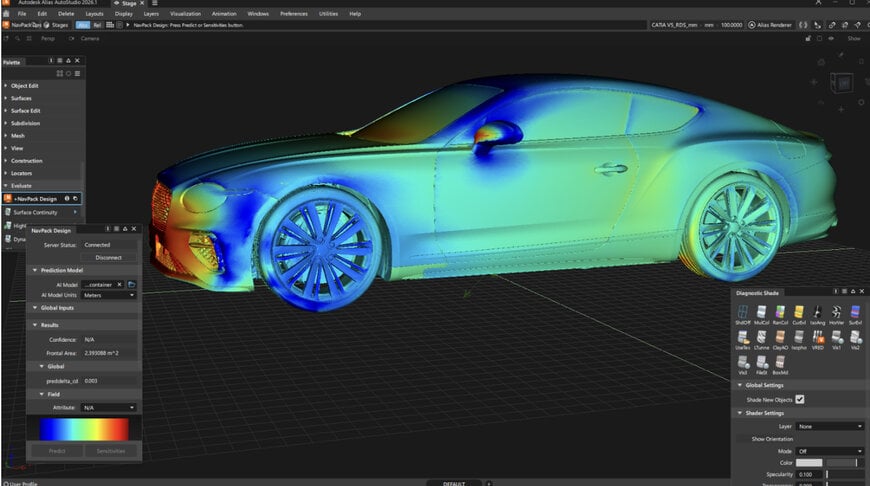
Autodesk and NVIDIA are expanding technical collaboration to integrate advanced artificial intelligence libraries into vehicle design software. This integration connects Autodesk NavPack with NVIDIA PhysicsNeMo and NVIDIA Warp to optimize predictive engineering workflows in the automotive sector.
Operational Challenge and System Integration
In traditional automotive manufacturing, styling and geometry creation occur separately from numerical simulation and aerodynamic validation. Designers working in Autodesk Alias generate surface data without immediate feedback on physical performance, creating iterative bottlenecks when downstream simulations reveal required geometric modifications. Bentley and other automotive engineering teams utilize Autodesk NavPack to bridge this gap by introducing predictive data models directly into the initial ideation phase. Cooperation between Autodesk and NVIDIA became necessary to combine domain-specific geometry tools with high-performance neural network architectures capable of real-time physics prediction.
Technical Architecture and Responsibilities
The technical architecture combines Autodesk NavPack software infrastructure with NVIDIA PhysicsNeMo and NVIDIA Warp libraries. Responsibilities are divided so that Autodesk provides the parametric design environment and core predictive toolsets, while NVIDIA supplies the GPU-accelerated computing libraries and AI model structures. The system operates by utilizing machine learning models trained on historical customer simulation datasets. These models process incoming geometric variations from Autodesk Alias, executing localized inference to calculate aerodynamic metrics such as drag coefficients without running full computational fluid dynamics solvers during the early design stage.
Deployment and Workflow Impact
The integration is deployed across hardware environments equipped with compatible graphics processing units capable of executing parallelized tensor operations. By shifting predictive insights upstream into the ideation phase, engineering teams reduce the frequency of costly redesign cycles. Thomas Heermann, vice president of Automotive Design at Autodesk, noted that aerodynamic prediction transforms the design environment by allowing critical engineering data to inform geometry creation from the start. Full-fidelity numerical simulations remain integrated for final model validation, ensuring compliance with required performance standards while minimizing time spent on iterative manual corrections.
Edited by Sucithra Mani, Induportals editor – adapted by AI.
www.autodesk.com
