
www.auto-innovations.net
14
'26
Written on Modified on
Autonomous Vehicle Open Source AI Architecture
Valeo and KE:SAI collaborate to build open-source physical AI foundation models for autonomous driving systems across diverse sensor configurations.
www.valeo.com
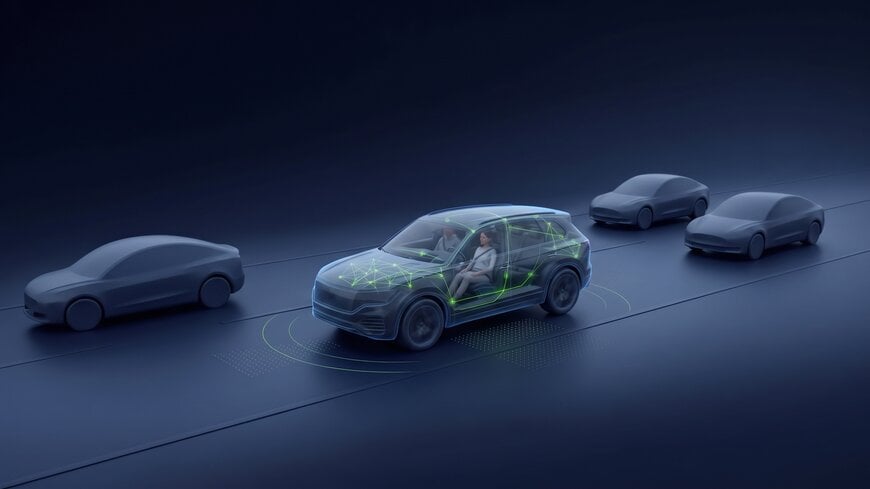
Valeo and research laboratory KE:SAI have established an open-science research partnership to develop an open-source, generalist AI architecture for autonomous driving systems in the automotive industry.
Industrial Challenge and Division of Expertise
Most autonomous driving software in the automotive sector remains proprietary. Automakers and tier-one suppliers lack standardized, reproducible baseline models to evaluate system performance, creating dependency on closed stacks that prevent cross-organizational verification. Furthermore, training robust models requires resolving edge-case behaviors and cross-platform generalization across varying hardware configurations.
To address this challenge, Valeo provides industrial automotive systems expertise alongside its artificial intelligence research team, valeo.ai, which developed models including DrivoR and VaVAM. KE:SAI, an initiative of Kyutai and the ELLIS Institute Tübingen, contributes benchmark development expertise from platforms such as KITTI, NAVSIM, and TransFuser. Combining industrial deployment parameters with open academic benchmarking enables the development of verifiable physical AI architectures.
Model Architecture and Training Methodology
The technical objective is a compact foundation model capable of cross-vehicle generalization across varied sensor suites, camera topologies, and operating environments.
The training pipeline uses large-scale, real-world driving datasets to establish baseline perceptual and control policies capable of cross-sensor transfer. To resolve scenarios where empirical data is sparse, the system incorporates closed-loop simulation training via reinforcement learning alongside learned world models. This exposes the decision-making network to rare safety-critical edge cases and dynamic interactions without physical testing risks.
Target Applications and Open-Source Delivery
The primary application focus is automated mobility, covering passenger vehicles and commercial transport fleets. The software architecture targets operational stability and consistent edge-case response across variable camera and radar/LiDAR sensor sets.
All deliverables — including source code, neural network weights, training datasets, and performance benchmarks — will be released publicly under open-source licenses. This shared reference stack allows external engineering teams to validate autonomous control policies against standardized driving benchmarks.
Technical Perspectives
Marc Vrecko, CEO of Valeo Brain: "By combining our deep industrial and technological expertise in autonomous driving with world-class open-source research, we are establishing a shared foundation to accelerate the development of physical AI and democratize next-generation self-driving technologies."
Andreas Geiger, CEO of KE:SAI: "For language models, open source compressed years of progress into months, yet frontier physical AI is still largely closed. Valeo shares our belief that open foundations create more innovation than any closed system ever could. Everything we develop will be open."
Edited by Evgeny Churilov, Induportals Media - Adapted by AI.
www.valeo.com
