
www.auto-innovations.net
06
'26
Written on Modified on
Dropwise Condensation Thermal Efficiency in Tire Vulcanization Presses
Kurita Water Industries deploys Kurita Dropwise Condensation Technology to enhance vulcanizer heat transfer and lower tire curing steam consumption.
www.kurita.co.jp
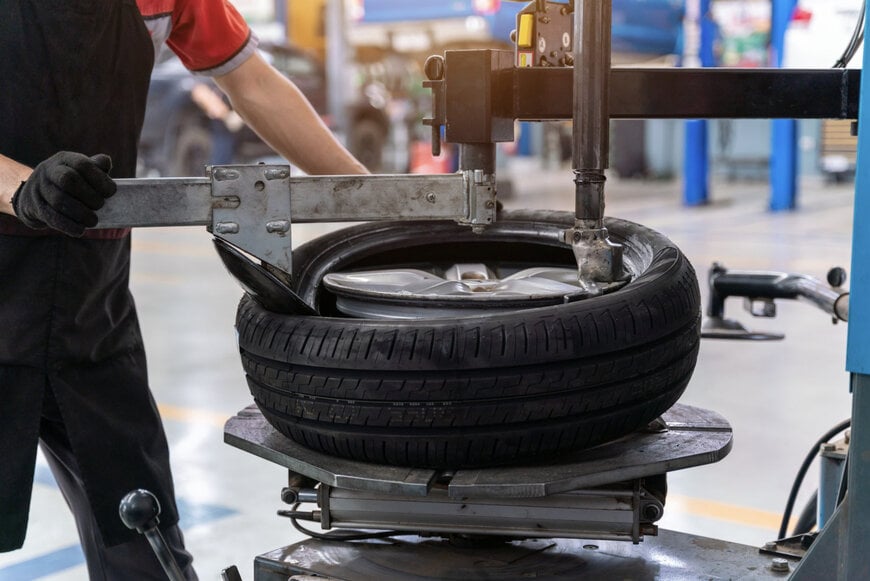
Industrial tire manufacturing requires intensive thermal energy inputs, where curing presses rely on saturated steam to deliver latent heat through curing bladders and molds to drive cross-linking reactions. To overcome thermal boundary resistance in existing curing assets without requiring press replacement, Kurita Water Industries introduced Kurita Dropwise Condensation Technology, a chemical dosing approach that modifies surface wettability to increase heat transfer efficiency during tire vulcanization.
Thermodynamic Resistance in Tire Curing Presses
During tire vulcanization, saturated steam releases its latent heat of condensation onto metallic platen walls and container mold cavities. In conventional operation, condensed water accumulates into a continuous liquid film across the metallic heat-transfer boundary. Liquid water exhibits poor thermal conductivity compared to structural steel or aluminum mold assemblies. As a consequence, this continuous condensate layer acts as an insulating thermal barrier, slowing heat flux into the green tire compound and forcing facilities to maintain elevated steam pressures or extended cycle durations.
Standard plant optimization programs target upstream steam boilers, distribution pipe insulation, trap diagnostics, and condensate return loops. While these measures address network-level distribution losses, they do not resolve the microscopic condensation mechanism occurring at the heat-transfer surface inside the curing press.
Interfacial Surface Modification and Dropwise Heat Flux
Kurita Dropwise Condensation Technology alters the surface tension characteristics at the steam-metal interface. By dosing a specialized chemical treatment into the steam supply upstream of target curing presses, the compound creates a water-repellent, hydrophobic monomolecular layer across internal heat-exchange boundaries.
This altered surface chemistry prevents the formation of a continuous liquid film. Saturated steam condenses into discrete, isolated droplets rather than a uniform sheet. These micro-droplets coalesce under gravitational and vapor shear forces, detaching rapidly from the metallic substrate and rolling down the vertical heat-exchange boundaries.
This continuous shedding leaves substantial portions of bare metal directly exposed to incoming steam vapor. By eliminating the insulating condensate barrier, the mechanism significantly decreases interfacial thermal resistance, yielding an immediate enhancement in overall heat transfer coefficients during the curing cycle.
Operational Implementation on Operating Manufacturing Assets
Traditional energy conservation initiatives in vulcanization shops typically require dedicated capital expenditures (CAPEX), extensive piping redesigns, auxiliary heat-recovery exchangers, or press mechanical retrofits that necessitate extended production shutdowns.
The Kurita Dropwise Condensation approach bypasses these mechanical constraints by interfacing directly with existing steam feed infrastructure. The chemistry is dosed into operating steam lines with minimal physical intervention, preventing production interruptions or tooling modifications.
Once the treatment establishes the hydrophobic film across platen chambers or internal press jackets, heat transfer increases without requiring alterations to vulcanizer geometries, bladder compounds, or mold metallurgy. The resulting thermal responsiveness allows manufacturers to evaluate steam savings and cycle stability immediately following baseline verification.
Multi-Site Industrial Deployments and Decarbonization Pathways
Deploying surface-altering chemical technology requires process compatibility validation across variable curing conditions, including multi-piece segment molds, container designs, and differing platen steam pressures. Kurita conducts technical evaluations and production trials across major tire-producing regions to verify repeatable heat flux gains across diverse press architectures.
Because the system relies on chemical surface modification rather than capital machinery retrofits, implementation scales across press lines and multi-site production facilities. Lowering the steam mass flow required to maintain curing temperatures decreases overall fuel consumption at the boiler house, providing tire manufacturers with an operational pathway to curb Scope 1 and Scope 2 carbon dioxide emissions across mature production assets.
Additional Context:
This section details technical specifications and competitive benchmarking not included in the original product announcement.
Dropwise condensation delivers heat transfer coefficients that are an order of magnitude higher than conventional filmwise condensation, typically yielding local heat transfer coefficients between 50,000 and 100,000 W/(m²·K), compared to 5,000 to 10,000 W/(m²·K) observed under continuous liquid film flow governed by Nusselt film condensation theory. In industrial tire curing presses, achieving dropwise condensation using Kurita's specialized formulation (such as Kurita DW-1108) can increase effective heat flux through platen walls by up to 30 percent, generating platen steam reductions between 3 and 15 percent and potential curing cycle productivity improvements up to 10 percent.
Engineering approaches to induce dropwise condensation historically depended on physical vapor deposition (PVD) of noble metals like gold or platinum, hydrophobic polymer coatings such as polytetrafluoroethylene (PTFE), or silane-based self-assembled monolayers (SAMs). While physical coatings achieve contact angles exceeding 100 degrees, they suffer mechanical abrasion, pinhole degradation, and delamination under the cyclical thermal stresses and steam-hammer transients common to industrial tire presses. Chemical dosed technologies, such as film-forming amines and Kurita's water-repellent organic formulations, continually replenish the functional monolayer from the vapor phase at concentrations of 15 to 20 mg/L in condensate, maintaining thermal performance without permanent surface recoating or fouling boiler feed water loops.
Edited by Natania Lyngdoh, Induportals editor, with AI assistance.
www.kurita.com
