
www.auto-innovations.net
29
'26
Written on Modified on
Yaskawa Electric and GAZOO Racing Advance Welding Technology
AI-powered autonomous robot production technology introduces to the GR KART manufacturing site based on knowledge gained from the sequence freezing arc welding process.
www.yaskawa.eu.com
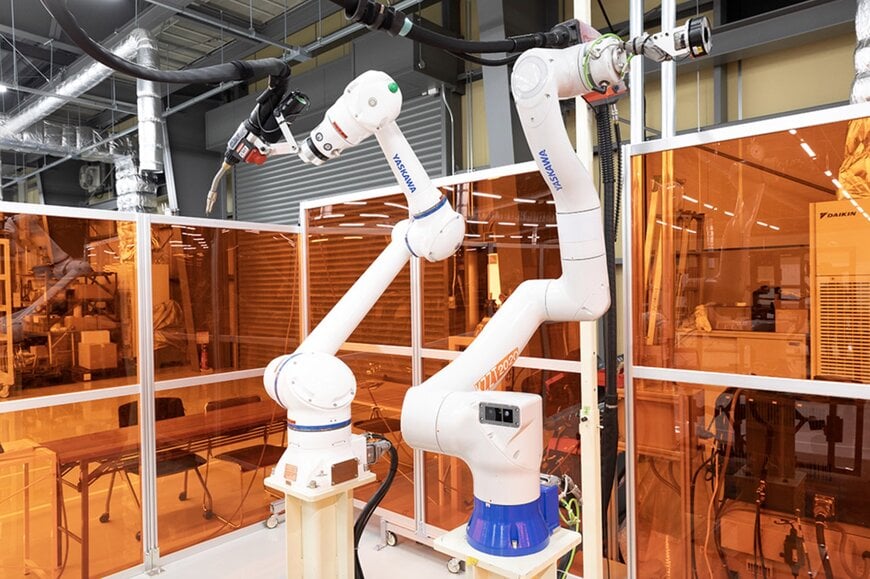
Industrial fabrication of tubular space frames for racing vehicles and go-karts presents severe automation challenges due to complex multi-axis joint intersections, variable gap tolerances, and thermal distortion. Historically, tubular pipe welding has relied on highly skilled manual welders capable of visually tracking joint variations, adjusting torch angles and travel speeds in real time, listening to arc sound characteristics, and manually grinding or re-welding defective passes. Fixed, deterministic robotic welding programs struggle in these environments; minor fit-up deviations or joint gap variances cause burn-through, lack of fusion, or structural porosity, necessitating labor-intensive post-weld inspection and manual rework. Overcoming these bottlenecks requires autonomous robotic platforms equipped with high-speed edge computing, adaptive vision sensing, multi-modal acoustic analysis, and closed-loop process correction directly on the production floor.
Autonomous Robotic Welding Architecture and Deployment
To overcome the challenges of manual pipe-frame fabrication, Yaskawa Electric Corporation partnered with GAZOO Racing (GR), the motorsports arm of Toyota Motor Corporation, to co-develop and deploy AI-driven autonomous robotic welding technology. Successfully implemented at the Gamagori GR KART Workshop in September 2026, the system handles the end-to-end manufacturing of GR KART tubular frames, improving quality consistency, reducing cycle times, and lowering overall fabrication costs.
The deployment is anchored by Yaskawa’s MOTOMAN NEXT robotic platform, which features integrated edge graphics processing units (GPUs) and specialized artificial intelligence processing directly within the robot controller environment. Moving beyond basic open-loop robotic welding, the MOTOMAN NEXT system uses its onboard AI decision-making algorithms to evaluate incoming joint gaps, assembly fits, and pipe alignments dynamically. The controller calculates real-time adjustments to travel speeds, weave patterns, and torch orientations before initiating the arc.
Multi-Modal Sensing, Closed-Loop Inspection, and SFA Lineage
The autonomous platform extends AI inspection and remediation across the entire joint lifecycle:
- In-Process Monitoring: AI models evaluate multi-modal process data during welding, simultaneously analyzing machine vision images, acoustic arc sound signatures, and electrical current/voltage waveforms to detect localized process deviations.
- Autonomous Correction: Following weld pass completion, the robot inspects the finished seam using optical vision algorithms to assess weld reinforcement, profile consistency, and surface flaws. If geometric defects are identified, the robot autonomously plans and executes corrective passes without human intervention.
- Sequence Freezing Arc Technology: The platform builds upon the Sequence Freezing Arc (SFA) welding process co-developed by Yaskawa and GR in 2024 for race car roll-cage manufacturing. That technology compressed roll-cage lead times from two-to-three weeks down to three days while reducing structural weight and qualifying for Super Taikyu Series endurance race cars.
By combining GR’s motorsport structural fabrication expertise with Yaskawa’s motion control and edge AI, the system automates pipe-frame operations that historically demanded master welders, validating the MOTOMAN NEXT architecture within a live serial production environment.
Additional Context
This section details technical specifications and competitive benchmarking not included in the original product announcement.
Tubular frame joints in motorsports and light racing vehicles are governed by stringent fabrication codes such as AWS D1.1 (Structural Welding Code – Steel) and FIA Appendix J regulations for safety cages. Space-frame intersections involve complex saddle cuts and fish-mouth joints where intersecting pipe walls meet at non-orthogonal angles, producing constantly shifting root openings and joint bevel depths across a single 360-degree weld profile. The Sequence Freezing Arc (SFA) process utilizes short-arc waveform manipulation, rapidly pulsing wire feed and current to freeze the molten weld puddle intermittently. This prevents molten pool sagging during out-of-position vertical and overhead passes on thin-walled chrome-moly (4130) or high-tensile carbon steel tubing, mitigating burn-through while minimizing the heat-affected zone to prevent brittle martensite formation.
Within the robotic welding and intelligent automation sector, Yaskawa’s MOTOMAN NEXT system benchmarks against adaptive welding solutions developed by Fanuc (ArcTool with iRVision and Seam Tracking), ABB (RobotStudio Arc Welding PowerPac with WeldGuide III), and Fronius (TPS/i with WireSense). While traditional adaptive welding relies on through-the-arc seam tracking (TAST) or dedicated laser triangulation scanning heads mounted to the torch, these conventional systems are often physically hindered by the tight clearances of intersecting tubular frames and cannot interpret complex joint defects. By embedding GPU-accelerated neural networks directly into the robot controller, Yaskawa runs inference on acoustic arc signatures and synchronized vision feeds simultaneously, identifying porosity or arc instability in real time and adjusting torch orientation on the fly without relying on bulky external sensor attachments.
Edited by Romila DSilva, Induportals Editor, with AI assistance.
