
www.auto-innovations.net
22
'26
Written on Modified on
Multimodal Sensor Fusion Architecture for In-Vehicle Detection Systems
Murata is demonstrating a hybrid architecture that combines 60 GHz radar with optical cameras to optimize occupant monitoring and safety restraint systems.
www.murata.com
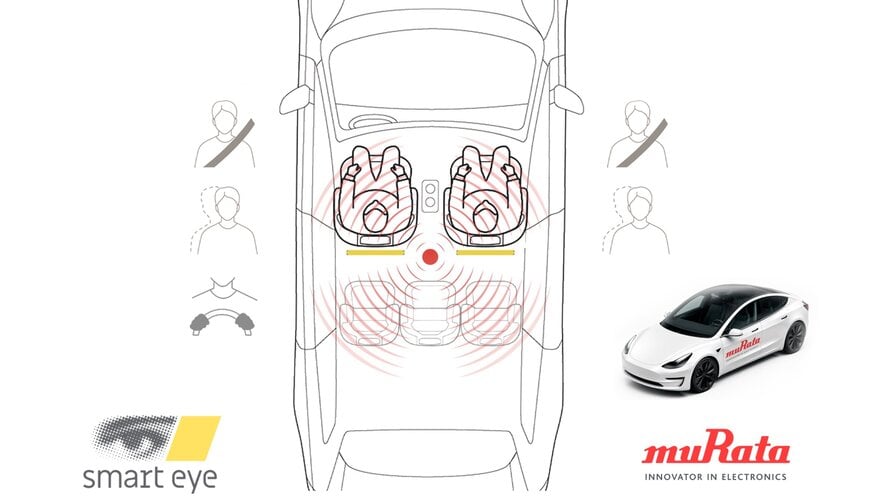
Murata Manufacturing Co., Ltd., in collaboration with Smart Eye, is introducing an integrated hardware and software architecture that fuses high-frequency radar data with AI-based optical detection. This multimodal approach is engineered for automotive original equipment manufacturers (OEMs) to consolidate Driver Monitoring Systems, Occupant Monitoring Systems, and Child Presence Detection into a unified interior sensing platform.
Technical Mechanisms of Multimodal Cabin Sensing
The architecture resolves the inherent limitations of standalone optical or radio-frequency sensors by merging their respective telemetry. In-cabin cameras, typically mounted in the overhead console or rearview mirror, capture high-resolution visual data regarding occupant posture, position, and behavioral metrics. However, optical systems degrade in low-light environments or when sightlines are obstructed.
To counteract visual occlusion, the system integrates automotive-grade 60 GHz millimeter-wave radar. This radar frequency easily penetrates non-conductive materials, such as heavy clothing or blankets, to map depth and detect concealed micromovements. Fusing these parallel data streams within an automotive data ecosystem enables the processing software to generate a persistent, high-fidelity spatial map of the vehicle interior regardless of ambient lighting conditions.
Hardware Optimization and Restraint System Integration
By leveraging overhead cameras and 60 GHz radar modules, automotive manufacturers can deprecate redundant, single-purpose physical sensors, such as weight-sensing floor mats or capacitive seat arrays. This hardware consolidation simplifies electrical wiring harnesses, reduces system integration complexity, and lowers the overall bill of materials (BOM) cost for interior manufacturing.
The precise spatial classification generated by this sensor fusion directly feeds into adaptive restraint systems. High-accuracy data regarding occupant size, seating position, and dynamic posture allows the vehicle control unit to optimize the deployment force of airbags and seatbelt pretensioners during a collision event. Additionally, utilizing radar depth telemetry alongside visual AI classifiers ensures highly reliable child presence detection while heavily reducing false alerts triggered by inanimate heavy objects placed on seats.
Scalability in Software-Defined Architectures
Deploying unified sensor hardware establishes a foundational platform capable of supporting expanded functionalities through over-the-air updates. Henrik Lind, Chief Research Officer at Smart Eye, notes that combining visual context with radar depth telemetry yields a common hardware platform that allows manufacturers to add subsequent software capabilities, ranging from gesture recognition to vital signs monitoring, without requiring physical component upgrades. This integrated methodology was showcased to Tier 1 suppliers at the InCabin/AutoSens exhibition to demonstrate its immediate viability for emerging software-defined vehicle architectures.
Additional Context
This section details technical specifications and competitive benchmarking not included in the original news release.
In the automotive interior sensing sector, the integration of 60 GHz radar has become a regulatory benchmark for Child Presence Detection, driven primarily by the stringent requirements established by the European New Car Assessment Programme (Euro NCAP). Competitors in the interior radar-camera fusion space include Tier 1 suppliers like Bosch and Aptiv, which also develop hybrid sensing suites. The accepted technical benchmark for these fusion architectures is the reduction of processing latency during sensor cross-validation and the accuracy of occupant classification, such as the system's ability to consistently distinguish a rear-facing infant seat from a heavy parcel. Purely optical systems typically suffer from a higher false-negative rate in zero-light scenarios, whereas 60 GHz radar provides millimeter-level accuracy for detecting cardiopulmonary micromovements, establishing the baseline engineering standard for continuous vital sign monitoring within vehicular environments.
Edited by Aishwarya Mambet, Induportals Editor, with AI assistance.
www.murata.com
