
www.auto-innovations.net
14
'26
Written on Modified on
Klingspor Expands Flap Disc Portfolio for Automotive Metalworking Applications
CMT, SMT & TITAN solutions provide quick changes, aggressive stock removal, extended life and cooler finishing across automotive grinding and fabrication tasks.
www.klingspor.com
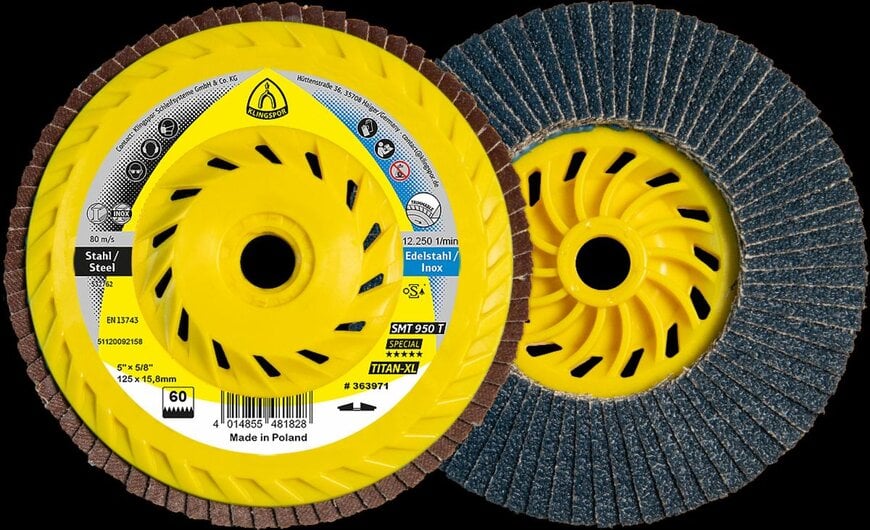
Klingspor Abrasives Inc. has presented its comprehensive flap disc portfolio, incorporating the CMT, SMT, and TITAN series to address high-precision grinding, weld blending, and surface finishing operations. Engineered specifically for automotive production lines, restoration facilities, and general metal fabrication, the abrasive line focuses on accelerating abrasive changeovers, managing thermal dissipation on heat-sensitive alloys, and reducing consumable wear across multi-stage finishing workflows.
Abrasive Architecture and Quick-Change Mechanics
Flap disc performance relies on progressive layer breakdown, wherein backing fabrics degrade at a calibrated rate alongside abrasive minerals to expose sharp cutting facets. Within industrial metalworking, operational bottlenecks frequently occur during mechanical disc exchanges and thermal discoloration on stainless alloys.
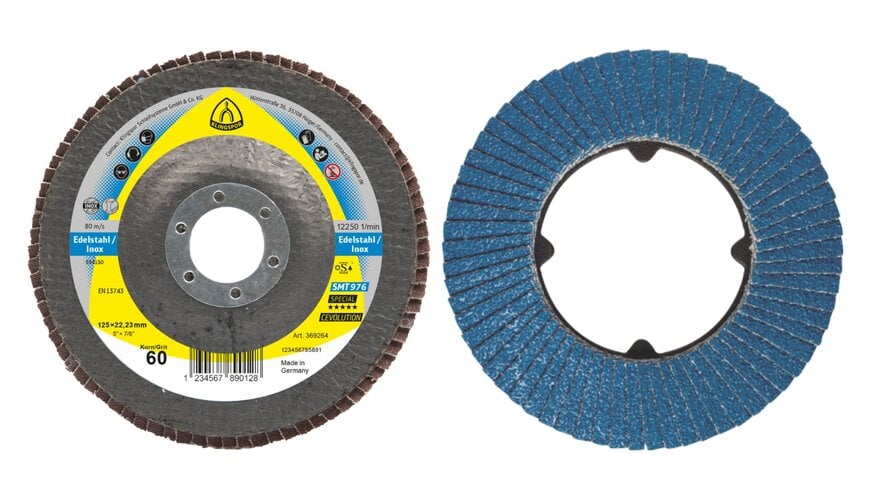
To address rapid turnover requirements in production environments, the CMT series provides a quick-change mechanical mounting interface directly integrated into a flap disc design. Available in convex and flat geometric configurations, these units use alumina zirconia abrasive grains as well as non-woven synthetic mesh structures. This profile selection permits direct switching between aggressive weld flattening and uniform surface preparation without requiring supplementary locknut tooling.
Graded Abrasive Media for Process Optimization
The SMT lineup organizes abrasive wear characteristics across three distinct performance tiers, allowing machine operators to match media degradation rates to grinder power outputs and workpiece hardness:
- The Extra 3 tier functions as an entry baseline for universal fabrication tasks on standard carbon steels, tuned for low-power angle grinders.
- The Supra 6 series balances stock removal aggression and media lifespan for consistent industrial duty cycles.
- The Special 9 series utilizes self-sharpening ceramic grain structures designed for sustained high-contact-pressure applications on hardened alloys and structural components.
To mitigate heat buildup on austenitic stainless steels and high-strength automotive body panels, selected SMT variants integrate non-woven combination flaps and topical multibond grinding aids. These chemical additives reduce surface friction at the interface zone, lowering operational temperatures to prevent thermal tinting, structural warping, and alloy sensitization during weld seam refinement.
Trimmable Backing Plates and Extended Duty Cycles
The TITAN series targets consumable longevity through a trimmable polymeric backing plate. When the outer abrasive grain margins wear down to the edge of the support structure, operators can mechanically trim the polymer rim against a clean metal edge, exposing unspent abrasive flap area that would otherwise be discarded. This construction extends total contact time per disc and reduces tooling replacement frequencies in continuous production settings.
The series incorporates a damping plastic backing plate to reduce hand-arm vibration transmitted to operators during sustained grinding tasks. Mounting is standardized via an integrated 5/8-inch-11 threaded hub for direct tool-free attachment to angle grinder spindles. Mineral options include ceramic and zirconia alumina variations, with specialized multibond coatings formulated to prevent wheel loading on ductile non-ferrous metals and stainless alloys.
Additional Context:
This section details technical specifications and competitive benchmarking not included in the original product announcement
Industrial flap discs are systematically classified by grain mineralogy, backing structure, and plate geometry according to standards such as ANSI B7.1 and EN 13743. In standard surface preparation benchmarking, flap disc performance is evaluated primarily by cut rate (grams of metal removed per minute) and aggregate material removal before disc expiration.
Comparative industrial solutions include the 3M Cubitron II 967A and Norton Quantum X series. The 3M platform relies on precision-shaped ceramic grains engineered with uniform geometric triangular points that fracture continuously into micro-replicated cutting edges, typically maximizing initial cut rates on heavy structural carbon steels. In contrast, the Klingspor TITAN architecture optimizes overall consumable efficiency through its trimmable thermoplastic core, recovering up to 25 percent of inner flap surface that rigid fiberglass-backed discs discard. Standard phenolic fiberglass backings, common to competing benchmark products from manufacturers like Weiler Abrasives (Tiger Paw series), provide higher rigid planar resistance under severe edge grinding but lack trimmability and require conventional mechanical mounting flanges unless fitted with spin-on metal hub inserts.
Edited by Natania Lyngdoh, Induportals editor, assisted by AI.
www.klingspor.com
Trimmable Backing Plates and Extended Duty Cycles
The TITAN series targets consumable longevity through a trimmable polymeric backing plate. When the outer abrasive grain margins wear down to the edge of the support structure, operators can mechanically trim the polymer rim against a clean metal edge, exposing unspent abrasive flap area that would otherwise be discarded. This construction extends total contact time per disc and reduces tooling replacement frequencies in continuous production settings.
The series incorporates a damping plastic backing plate to reduce hand-arm vibration transmitted to operators during sustained grinding tasks. Mounting is standardized via an integrated 5/8-inch-11 threaded hub for direct tool-free attachment to angle grinder spindles. Mineral options include ceramic and zirconia alumina variations, with specialized multibond coatings formulated to prevent wheel loading on ductile non-ferrous metals and stainless alloys.
Additional Context:
This section details technical specifications and competitive benchmarking not included in the original product announcement
Industrial flap discs are systematically classified by grain mineralogy, backing structure, and plate geometry according to standards such as ANSI B7.1 and EN 13743. In standard surface preparation benchmarking, flap disc performance is evaluated primarily by cut rate (grams of metal removed per minute) and aggregate material removal before disc expiration.
Comparative industrial solutions include the 3M Cubitron II 967A and Norton Quantum X series. The 3M platform relies on precision-shaped ceramic grains engineered with uniform geometric triangular points that fracture continuously into micro-replicated cutting edges, typically maximizing initial cut rates on heavy structural carbon steels. In contrast, the Klingspor TITAN architecture optimizes overall consumable efficiency through its trimmable thermoplastic core, recovering up to 25 percent of inner flap surface that rigid fiberglass-backed discs discard. Standard phenolic fiberglass backings, common to competing benchmark products from manufacturers like Weiler Abrasives (Tiger Paw series), provide higher rigid planar resistance under severe edge grinding but lack trimmability and require conventional mechanical mounting flanges unless fitted with spin-on metal hub inserts.
Edited by Natania Lyngdoh, Induportals editor, assisted by AI.
www.klingspor.com
