
www.auto-innovations.net
15
'26
Written on Modified on
Nanofiber Air Filtration Enhances Commercial Vehicle Performance
MANN+HUMMEL has introduced nanofiber air filter media for commercial vehicles to improve particle separation, extend filter service life, and maintain low airflow resistance under demanding operating conditions.
www.mann-hummel.com
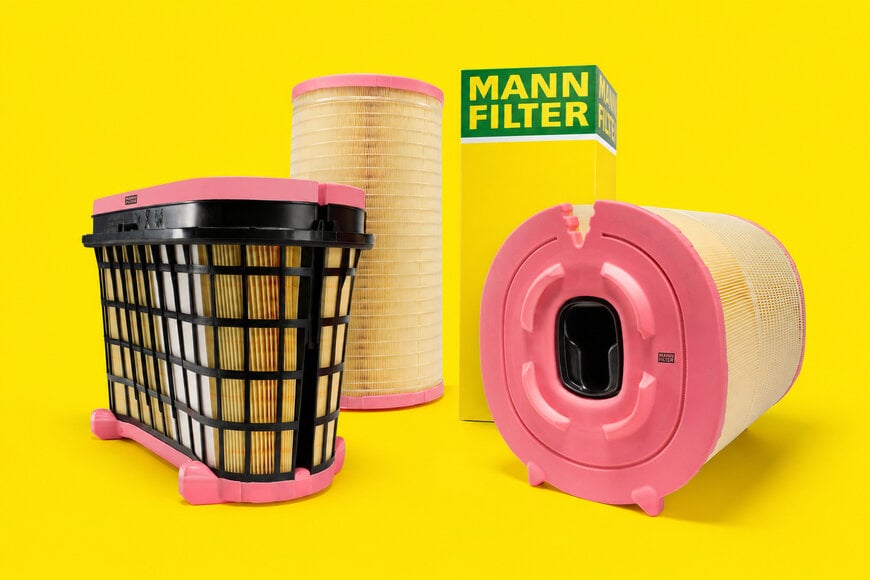
Commercial vehicle engines operating in construction, mining, logistics, and long-haul transport are exposed to high concentrations of airborne dust and fine particles that accelerate engine wear and increase maintenance requirements. MANN+HUMMEL has expanded its nanofiber filtration technology for selected MANN-FILTER air filters, providing a filtration solution designed to improve engine protection while supporting longer maintenance intervals in heavy-duty applications.
Nanofiber Media Improves Heavy-Duty Air Filtration
The new filtration media combines a cellulose carrier with an ultra-thin layer of polymer nanofibers developed and manufactured entirely by MANN+HUMMEL. The company is among the few filtration manufacturers that design and produce their own nanofiber media, allowing greater control over material composition, manufacturing processes, and filtration performance.
The technology has been introduced in selected aftermarket air filters, including the C 50 004/1 for the Mercedes-Benz Actros II, the C 26 024 Kit for DAF XF 105 and XF 106 trucks, and the C 29 046 for the latest DAF XG generation. These filters are intended for commercial vehicles operating in environments with continuous exposure to dust, soot, and other airborne contaminants.
Particle Separation and Dust-Holding Capacity
The nanofiber layer consists of polymer fibers with an average diameter between 0.13 and 0.15 micrometers. These fibers are approximately 300 times finer than the cellulose base material and up to 500 times finer than a human hair. Their extremely small diameter increases the available filtration surface, allowing particles to accumulate on the surface of the filter rather than penetrating into the substrate.
According to MANN+HUMMEL, conventional cellulose media capture approximately 40% of particles within this size range, whereas the nanofiber media achieves particle separation efficiency of up to 99.98%. By retaining contaminants on the filter surface, the media reduces pore blockage within the cellulose layer, increases dust-holding capacity, and supports extended service intervals without compromising filtration performance.
Optimized Airflow for Commercial Vehicle Engines
High filtration efficiency is only one requirement for modern heavy-duty air intake systems. Excessive airflow restriction can reduce engine performance and increase fuel consumption. The nanofiber structure maintains low flow resistance while preserving a stable fiber network that minimizes the risk of media damage during operation.
The filter media also incorporates flame-retardant impregnation to improve safety within the air induction system and provides high resistance to moisture. These characteristics enable reliable operation in demanding environments where vehicles are regularly exposed to varying temperatures, humidity, and heavy dust loads.
Jörg Schömmel, Senior Range Manager IAM at MANN+HUMMEL, stated that the company's proprietary nanofiber media is the result of research carried out by nearly 1,100 researchers and developers worldwide. The exclusive filter media combines nanofiber technology, long service life, and optimized airflow characteristics for commercial vehicle filtration applications.
Industry Applications
The nanofiber air filters are intended for heavy-duty diesel engines used in long-distance transportation, construction equipment, mining vehicles, municipal fleets, and other commercial vehicle applications where maintaining clean intake air is essential for protecting turbochargers, mass airflow sensors, and internal engine components. Improved filtration efficiency can also contribute to reduced maintenance frequency and lower operating costs over the service life of the vehicle.
Additional Context: This section details technical specifications and competitive benchmarking not included in the original product announcement.
Nanofiber media has become an established technology in heavy-duty engine air filtration because it combines high particle capture efficiency with low pressure drop. Filtration performance is commonly evaluated using ISO 5011, the international test standard for heavy-duty engine air cleaners, which measures filtration efficiency, dust-holding capacity, and airflow restriction under controlled laboratory conditions.
MANN+HUMMEL reports particle separation efficiency of up to 99.98% for its proprietary nanofiber media. Comparable technologies include Donaldson's Ultra-Web nanofiber media, which also uses surface-loading filtration to capture contaminants before they penetrate the cellulose substrate. Donaldson reports filtration efficiencies of up to 99.99% under ISO 5011 testing while emphasizing extended filter life and reduced airflow restriction. Fleetguard has adopted a similar approach with its NanoNet media, using synthetic nanofiber structures to improve contaminant retention and extend filter service intervals in heavy-duty engine applications. Although manufacturers use different media constructions and validation methods, the primary benchmark remains the balance between filtration efficiency, airflow resistance, and dust-holding capacity measured according to ISO 5011.
Edited by Sucithra Mani, Induportals Editor – adapted by AI.
www.mann-hummel.com
