
www.auto-innovations.net
23
'26
Written on Modified on
Integrating hydrogen combustion architectures with heavy-duty commercial vehicle platforms
Daimler Truck and KEYOU are collaborating to convert existing internal combustion engine blocks for gaseous hydrogen operation.
www.daimlertruck.com
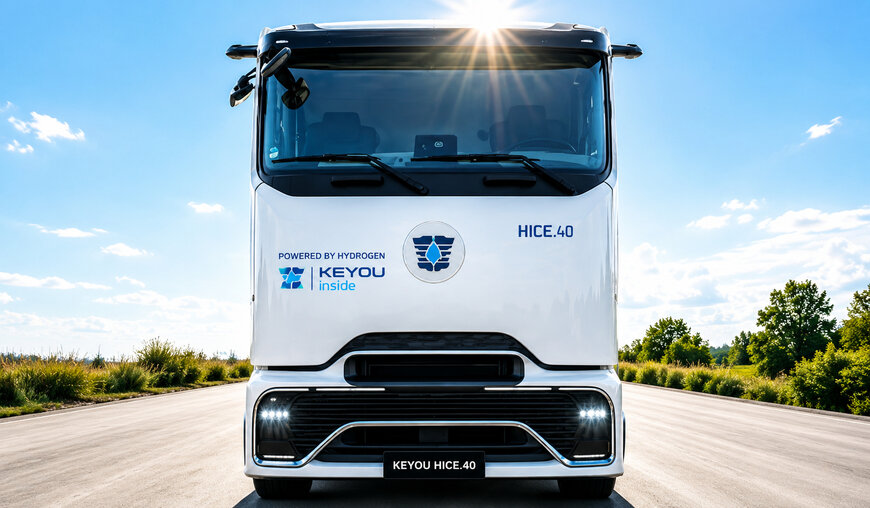
The technical cooperation integrates zero-emission gaseous fuel delivery components with established high-displacement diesel powertrain designs. The partnership adapts mass-production commercial vehicle chassis to utilize hydrogen internal combustion engines, targeting long-haul logistics fleets, heavy-duty road freight transport, and industrial automation networks.
Infrastructure strain and payload constraints in heavy long-haul transport
Decarbonizing heavy-duty commercial vehicles faces significant engineering bottlenecks when relying solely on battery-electric or fuel-cell powertrains. Battery-electric configurations introduce substantial weight penalties that reduce maximum legal cargo capacity, while fuel-cell modules require complex thermal management systems and high-purity hydrogen filtration to avoid catalyst poisoning.
Furthermore, scaling battery fleets places severe loads on localized electrical grids, requiring multi-megawatt charging terminals that demand extensive high-voltage network upgrades. To achieve rapid deployment without restructuring factory assembly lines, the commercial vehicle sector requires robust, lower-complexity powertrains that can be integrated directly into existing engine bays.
Port fuel injection and modular conversion mechanics
The joint engineering framework converts standard production diesel trucks into hydrogen internal combustion engine (HICE) vehicles. Under the industrial division of tasks, Daimler Truck supplies completely assembled truck chassis and heavy-duty engine blocks, while KEYOU executes the mechanical and algorithmic adaptation for hydrogen combustion.
The system responsibilities are partitioned between the technical partners to leverage specialized capabilities:
- Daimler Truck components: Manufactures and delivers the baseline chassis and the 12.8-liter internal combustion engine platform from its Mannheim production facility.
- KEYOU components: Integrates its proprietary engine modification packages, coordinates with external conversion partners for vehicle assembly, and oversees the fuel delivery installation.
The conversion relies on a low-pressure port fuel injection (PFI) system to deliver gaseous hydrogen into the intake air streams. Because hydrogen exhibits high flame speeds and wide flammability limits, the engineering teams modify the cylinder head geometry and spark-ignition timing parameters to eliminate pre-ignition anomalies. The adapted 12.8-liter engine platform outputs up to 350 kW of power while retaining the standard mechanical durability and thermal boundaries of the original heavy-duty block.
Phased rollout and fleet infrastructure deployment
The initial implementation phase utilizes a parallel supply chain approach where finished vehicles are modified post-production. The preliminary commercial model, designated as a 40-ton tractor unit, is scheduled for market launch in 2027.
The technical deployment involves integrating an onboard 350-bar compressed gaseous hydrogen storage assembly. The storage system feeds the port injection matrix continuously to enable a operating range of up to 650 kilometers under standard freight loading cycles. Subsequent validation steps will include testing existing service and maintenance networks to manage high-pressure gas seals and ignition component diagnostics without interrupting fleet availability.
Quantifiable benefits and structural impact
Utilizing an existing 12.8-liter engine platform minimizes capital expenditure by exploiting established engine manufacturing tooling and block casting lines. The compact design fits directly into standard engine space parameters, maintaining identical truck aerodynamics and axle load distributions. By utilizing 350-bar gaseous fuel systems, the architecture enables rapid refueling times comparable to conventional diesel assets, optimizing fleet duty cycles and relieving power grid congestion by introducing a parallel, stable energy vector for heavy long-haul transport.
Edited by Sucithra Mani, Induportals editor – adapted by AI.
www.daimlertruck.com
Phased rollout and fleet infrastructure deployment
The initial implementation phase utilizes a parallel supply chain approach where finished vehicles are modified post-production. The preliminary commercial model, designated as a 40-ton tractor unit, is scheduled for market launch in 2027.
The technical deployment involves integrating an onboard 350-bar compressed gaseous hydrogen storage assembly. The storage system feeds the port injection matrix continuously to enable a operating range of up to 650 kilometers under standard freight loading cycles. Subsequent validation steps will include testing existing service and maintenance networks to manage high-pressure gas seals and ignition component diagnostics without interrupting fleet availability.
Quantifiable benefits and structural impact
Utilizing an existing 12.8-liter engine platform minimizes capital expenditure by exploiting established engine manufacturing tooling and block casting lines. The compact design fits directly into standard engine space parameters, maintaining identical truck aerodynamics and axle load distributions. By utilizing 350-bar gaseous fuel systems, the architecture enables rapid refueling times comparable to conventional diesel assets, optimizing fleet duty cycles and relieving power grid congestion by introducing a parallel, stable energy vector for heavy long-haul transport.
Edited by Sucithra Mani, Induportals editor – adapted by AI.
www.daimlertruck.com
