
www.auto-innovations.net
18
'26
Written on Modified on
Daimler Truck Demonstrates Real-World Potential of Electric Logistics
Operational data from Mercedes-Benz eActros fleets highlight long-haul viability, lower emissions, and economic benefits.
www.daimlertruck.com
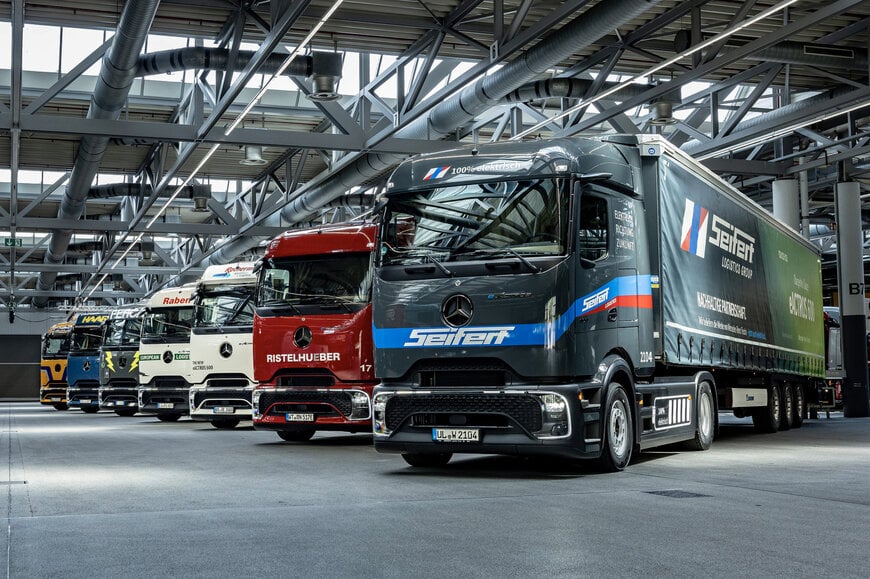
Daimler Truck has integrated approximately 80 battery-electric Mercedes-Benz eActros vehicles into its internal digital supply chain to achieve zero-emission logistics across its German manufacturing network. Operating at production facilities in Gaggenau, Kassel, Mannheim, and Wörth am Rhein, this heavy-duty vehicle fleet replacement leverages real-world operational data to validate the total cost of ownership viability of electric commercial transport. The strategic transition addresses industry-wide requirements for road freight decarbonization while maintaining rigid automotive production schedules.
Operational Fleet Validation via Telemetry Analysis
To evaluate the mechanical and economic reliability of zero-emission logistics under real-world conditions, a comprehensive telemetry study was executed between November and March. The data collection program analyzed over 3,000 distinct freight tours and 3,100 high-power charging events across a control group of more than 15 vehicles in active fleet service.
The empirical results from this evaluation confirm that heavy-duty battery-electric vehicles maintain identical uptime and delivery reliability compared to traditional diesel configurations during regular series manufacturing operations. The aggregate mileage accumulated by the first and second-generation eActros trucks, primarily the eActros 600 model line, has surpassed six million electric miles, demonstrating continuous component durability across diverse seasonal cycles.
Economic Viability and Technical Use Cases in Long-Haul Freight
Real-world transport routes confirm that heavy-duty electric trucks optimize the total cost of ownership through road-toll exemptions and predictable energy consumption parameters. In long-haul transport logistics, an eActros 600 configuration operating with an average gross combination weight of 36 metric tons covers a daily distance of 600 kilometers between Wörth am Rhein and Bielefeld.
Data logged during winter operations between November and February recorded an average energy consumption of 100 kWh per 100 kilometers, which is energetically equivalent to approximately 11 liters of diesel fuel per 100 kilometers. On this specific high-mileage corridor, the elimination of road toll fees generates operational savings exceeding 4,000 euros per month while mitigating 90 metric tons of carbon dioxide equivalent emissions annually.
A separate high-volume international long-haul deployment through challenging Alpine topography from South Tyrol, Italy, to Wörth am Rhein operates with a gross combination weight up to 42 metric tons. Despite steep geographic gradients and sub-zero winter temperatures, the vehicle achieved an average energy consumption of 92 kWh per 100 kilometers, heavily supported by an energy recovery rate of 25 kWh per 100 kilometers via regenerative braking. This operating efficiency yields a monthly toll cost reduction of 3,900 euros and annual carbon emission reductions of 90 metric tons.
Cost Optimization in High-Frequency Shuttle Operations
The economic advantages of heavy-duty battery-electric platforms are pronounced in short-haul, high-frequency shuttle configurations where charging infrastructure is integrated into existing loading times. In a high-utilization shuttle application between Germersheim and Wörth am Rhein, three eActros units replaced conventional diesel vehicles to execute eight daily transport runs over a total distance of 352 kilometers.
Operating with an average gross weight of 30 metric tons, the shuttle vehicles recorded an average consumption of 114 kWh per 100 kilometers, equivalent to 12 liters of diesel fuel per 100 kilometers. By executing complete battery charging cycles strictly during scheduled material loading and unloading windows, the fleet eliminates auxiliary operational downtime. This high-utilization cycle generates more than 2,300 euros in monthly toll savings and reduces annual carbon dioxide equivalent emissions by 56 metric tons per route.
High-Capacity Energy Storage and Modular Platform Architecture
The technical foundation of the heavy-duty long-haul platform relies on three lithium iron phosphate battery packs providing a total installed nominal capacity of 621 kWh. Lithium iron phosphate cell chemistry provides an unconstrained usable energy threshold, allowing operators to utilize more than 95 percent of the total installed capacity to maximize range.
The vehicle drive architecture utilizes an in-house developed electric drive axle integrating dual electric motors and a specialized four-speed transmission. This powertrain configuration supports a standard operating range of 500 kilometers on a single charge under a gross combination mass of 40 tons, a distance that can be extended beyond 1,000 kilometers per day via intermediate charging during mandatory driver rest periods.
The vehicle is engineered to meet a structural durability standard of 1.2 million kilometers over ten years of continuous operation, at which point the battery state of health is designed to remain above 80 percent. Built on a technical specification accommodating a gross combination mass up to 44 metric tons, the chassis provides a standard European Union payload capacity of approximately 22 tons when paired with a standard semi-trailer.
To accommodate diverse automotive data ecosystem applications, the platform portfolio has been expanded to 40 distinct vehicle variants, including the eActros Lowliner developed specifically for high-volume logistics. These multi-axle configurations enter series production in the second quarter of 2027 following official commercial ordering availability in the third quarter of 2026.
Additional Context:
This section details technical specifications and competitive benchmarking not included in the original product announcement
The eActros 600 enters an expanding heavy-duty electric tractor market where it faces direct competition from long-haul platforms such as the Volvo FH Electric series and the MAN eTGX. While early heavy-duty electric trucks utilized a modular adaptation of conventional chassis by placing central electric motors in the traditional transmission tunnel, current architectural standards have shifted toward integrated electric axles to optimize space for larger energy storage systems.
A key technical differentiation lies in battery cell chemistry and voltage configuration. Daimler Truck utilizes lithium iron phosphate cells within the Mercedes-Benz platform, prioritizing cyclic longevity and thermal stability to guarantee 1.2 million operating kilometers before the battery state of health degrades past 80 percent. In contrast, the Volvo FH Electric platform relies on nickel-manganese-cobalt chemistry, which offers higher volumetric energy density but follows alternative thermal degradation pathways over extended fast-charging cycles. Volvo overcomes spatial limitations by packing up to six distinct battery modules along the frame rails to deliver a maximum capacity of 540 kWh to 780 kWh depending on the specific configuration.
In terms of charging infrastructure interfaces, the eActros 600 is technically prepared for the Megawatt Charging System standard, enabling a 20 to 80 percent charge in approximately 30 minutes. This matches the capabilities of the MAN eTGX platform, which utilizes a modular battery configuration up to six packs yielding 480 kWh. While MAN focuses on lower curb weight to maximize legal payload capabilities up to the 44-metric-ton limit, the eActros 600 architecture prioritizes maximum unassisted range, capitalizing on the high usable energy percentage inherent to lithium iron phosphate cells to achieve its 500-kilometer rating without auxiliary charging.
Edited by Natania Lyngdoh, Induportals editor, assisted by AI.
www.daimlertruck.com
