
www.auto-innovations.net
09
'26
Written on Modified on
High-Performance Binders for the Next Generation of Electric Vehicle Batteries
BASF introduces Oppanol N PLUS, a highly elastic polyisobutene binder optimized for the strict mechanical and chemical demands of solid-state batteries.
www.basf.com
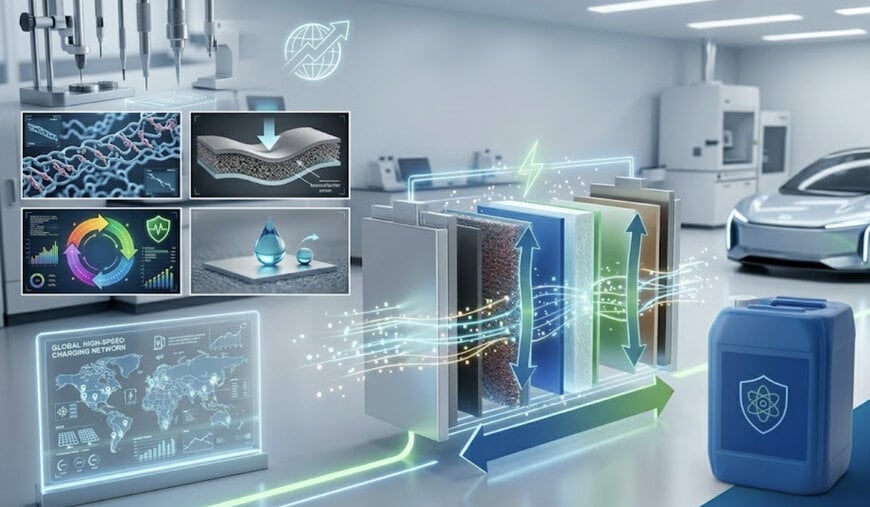
The market launch of Oppanol N PLUS directly addresses the technological hurdles in scaling solid-state batteries (SSB). While this next generation of batteries promises significant advances in energy density, charging times, and intrinsic safety, it places extremely high demands on the structural integrity of internal components. The new binder will be presented to the specialist audience at the Battery Show Europe from June 9 to 11, 2026, in Stuttgart.
Mechanical Stabilization and Chemical Inertness in the Battery Cycle
Within modern battery cells, the binder assumes a critical mechanical and electrochemical function in the cathode, anode, or electrolyte layer. During continuous charging and discharging processes, drastic volume changes occur in the electrodes due to the intercalation of ions. Oppanol N PLUS is based on an advanced polyisobutene (PIB) technology characterized by extremely high elasticity and extensibility. This allows the occurring mechanical stresses to be compensated for in a material-saving manner, minimizing crack formation and ensuring the long-term cycle stability of the cell. Since the polymer is completely chemically inert, parasitic side reactions with highly reactive battery materials are effectively prevented.
The optimized product configuration provides manufacturing companies with distinct advantages within the production chain:
- Narrow specifications: High and consistent product quality reduces batch fluctuations in large-scale industrial production.
- Process stability: The need for time-consuming reformulations at the customer end decreases, minimizing quality control efforts.
- Flexible logistics: Fast availability directly from stock as well as smaller container sizes from 20 kilograms facilitate flexible process adaptation.
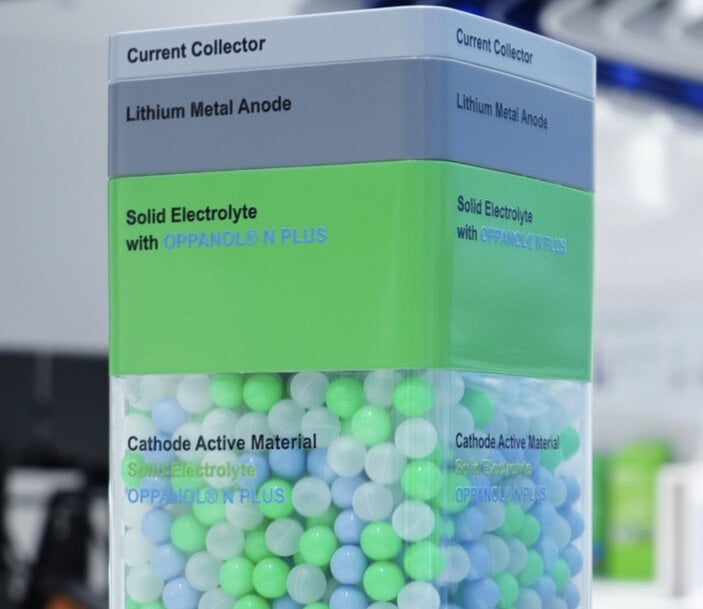
95 Years of PIB Technology: From Cable Insulation to High-Tech Battery
The introduction of this modern battery material coincides with the 95th anniversary of polyisobutene technology at BASF. Since Michael Otto discovered the polymerizability of isobutene in 1931 and its subsequent patenting, the property profile of the polymer known under the name "Oppanol" has steadily expanded. Its characteristic features—gas and water vapor impermeability, chemical resistance, transparency, and tackiness—made it a universal material that today ranges from insulating glass and pipeline coatings to the newest applications in the automotive data ecosystem for electromobility.
Additional Context: This section details technical specifications and competitive benchmarking not included in the original product announcement
In classical lithium-ion battery production, polyvinylidene fluoride (PVDF) is the dominant binder for cathodes. However, PVDF requires the use of toxic N-methyl-2-pyrrolidone (NMP) as a solvent, necessitating expensive recovery systems in the factory and burdening the environmental balance. When developing solid-state batteries, PVDF also reaches chemical limits, as many solid electrolytes—particularly sulfidic systems—are highly reactive toward polar polymers or residual solvents.
The non-polar, purely hydrocarbon-based polyisobutene (PIB) from BASF offers a decisive chemical advantage here. Since it has no functional groups, it shows excellent compatibility with sensitive solid electrolytes. Compared to alternative binders like styrene-butadiene rubber (SBR) or classic acrylate binders, which are frequently used in water-based anode processes, Oppanol N PLUS is characterized by extremely low moisture absorption. This is essential for solid-state systems, as even the smallest traces of water can irreversibly damage the cell.
Another technological benchmark concerns the processing method: the industry is increasingly moving toward solvent-free dry coating of electrodes (Dry Electrode Coating). Due to their viscoelastic properties, PIB binders are excellently suited for these dry mixing and calendering processes, as they can form stable, network-like structures under shear influence without sticking or blocking the pore structure of the electrode. By providing narrower molecular specifications in the "N PLUS" variant, BASF succeeds in minimizing viscosity fluctuations during calendering, which significantly reduces scrap rates in the digital supply chain of battery giga-factories.
Edited by Maria Brueva, Induportals editor – adapted by AI.
www.basf.com
