
www.auto-innovations.net
28
'26
Written on Modified on
High-Isolation Reed Relays For Electric Vehicle Insulation Testing
Pickering Electronics details the operational mechanisms of reed relays in high-voltage measurement applications for automotive drivetrains and charging infrastructure.
www.pickeringtest.com
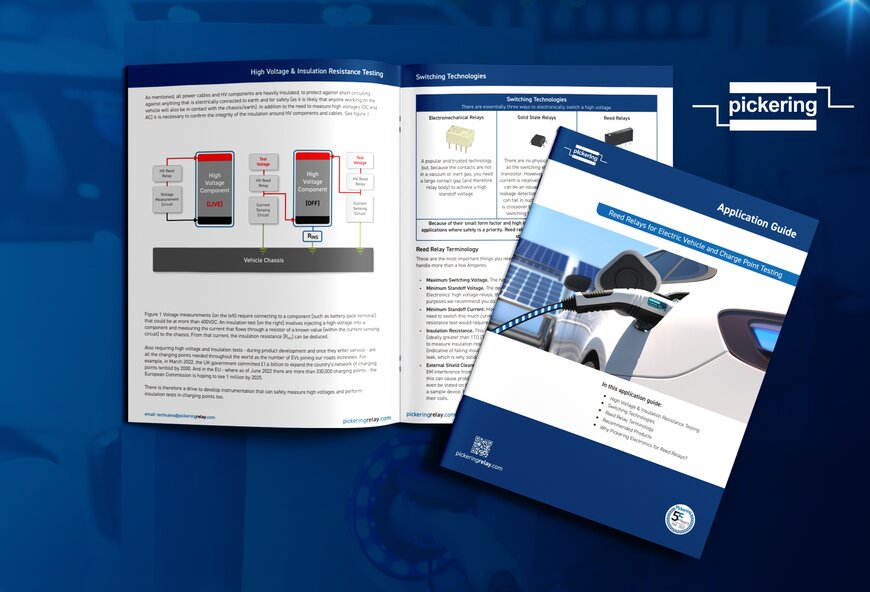
The electrification of automotive drivetrains relies on high-voltage components, including battery management systems (BMS), power inverters, and drive motors. In electric vehicles (EVs), hybrid electric vehicles (HEVs), and plug-in hybrid electric vehicles (PHEVs), these high-voltage architectures operate as floating systems. Because the power terminals are not earthed to the vehicle chassis, physical insulation is strictly required across all components and high-current cables to prevent short circuits. Verifying the integrity of this electrical insulation necessitates test equipment capable of withstanding high stand-off voltages while maintaining accurate diagnostic measurements.
Instrumentation and Diagnostics Requirements
Manufacturing, maintenance, and recovery procedures for electric vehicles require specialized diagnostic equipment to measure both direct current (DC) and alternating current (AC) high voltages. These diagnostic tools must confirm that insulation remains intact, protecting operators who may come into contact with the vehicle chassis. Parallel testing requirements apply to charging point infrastructure, where continuous high-voltage switching and insulation verification are necessary during both product development and active deployment.
Operational Mechanisms of Reed Relays
To address the switching requirements of these test environments, reed relays provide a mechanical contact path capable of isolating both AC and DC loads. Robert King, Reed Relays Product Manager at Pickering Electronics, notes that the physical separation provided by reed relays minimizes leakage currents that would otherwise skew insulation resistance measurements. In compact test architectures, these components can maintain leakage currents below one nanoampere (1 nA) while supporting stand-off voltages of several kilovolts (kV).
Structural Design and Signal Integrity
The internal architecture of a reed relay utilizes hermetically sealed contacts, preventing the ingress of moisture, dust, and atmospheric contaminants that typically oxidize or degrade open electromechanical contacts. This internal sealing provides galvanic isolation, which is critical for protecting sensitive downstream instrumentation electronics from high-voltage transients. The relays are constructed using a formerless coil design and incorporate Mu-metal screening. The Mu-metal shield contains the magnetic field generated by the internal coil, allowing multiple relays to be mounted in high-density arrays without magnetic interference affecting the switching performance of adjacent components.
Additional Context: This section details technical specifications and competitive benchmarking not included in the original product announcement.
In high-voltage switching and instrumentation applications, reed relays are frequently evaluated against solid-state relays (SSRs) and standard electromechanical relays (EMRs). While SSRs operate without moving parts and offer virtually infinite lifespans, they inherently exhibit higher off-state leakage currents—often in the microampere to milliampere range. This leakage compromises the precision required for megaohm or gigaohm insulation resistance testing in EV applications. Conversely, standard EMRs can handle substantial current loads but generally operate with slower actuation speeds and are susceptible to contact oxidation due to unsealed enclosures. Reed relays address these specific instrumentation requirements by combining the low contact resistance and sub-nanoampere off-state leakage of mechanical switches with actuation times typically under one millisecond, making them highly suited for precision high-impedance testing arrays.
Edited by an industrial journalist, Lekshman Ramdas, with AI assistance.
www.pickeringrelay.com
