
www.auto-innovations.net
24
'26
Written on Modified on
Active Electromechanical Suspension Architectures for Software-Defined Vehicles At Auto China 2026
In Beijing (April 24–May 3), Marelli develops smart actuators and software-controlled chassis systems to optimize vehicle dynamics and energy efficiency within the automotive data ecosystem.
www.marelli.com
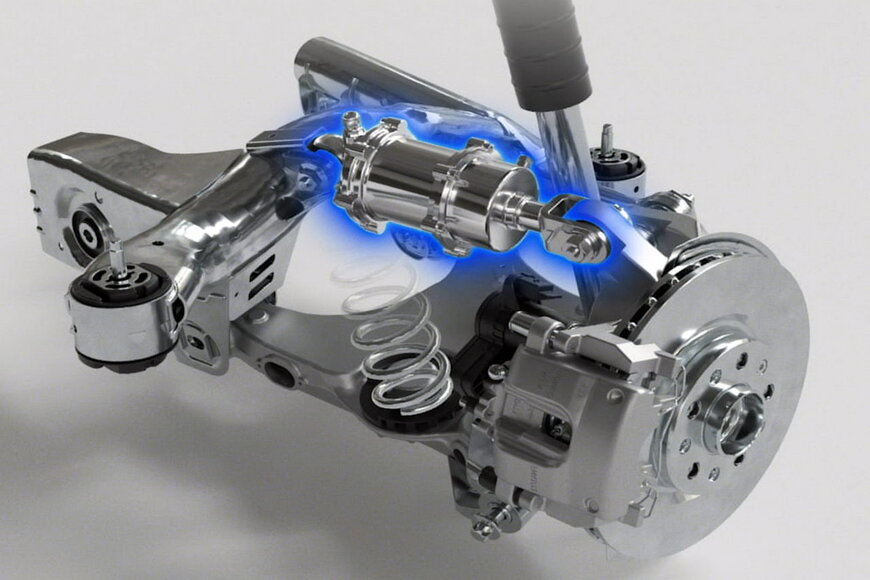
Active suspension and chassis systems are transitioning from passive mechanical components to software-integrated electromechanical actuators that define vehicle behavior in real time. These technologies are critical for the development of Software-Defined Vehicles (SDVs), where electronic control units (ECUs) manage physical dynamics to enhance safety, passenger comfort, and brand-specific handling characteristics across various propulsion platforms.
Real-Time Dynamics via Active Camber Control
A primary challenge in vehicle stability is maintaining the optimal tire contact patch during high-lateral-acceleration maneuvers. At Auto China 2026, technical specifications were presented for an Active Camber system designed to address this. The system utilizes an electronically controlled smart actuator equipped with integrated sensors to monitor road surfaces.
The architecture employs an intelligent control unit that processes sensor telemetry every millisecond. By adjusting the inward or outward tilt of the wheels in real time, the system compensates for body roll and road irregularities. This mechanical adjustment ensures maximum grip during braking and cornering, which reduces uneven tire wear and improves overall longitudinal and lateral acceleration performance.
Electromechanical Height Adjustment and Aerodynamic Optimization
For performance segments and sport utility vehicles, the Electromechanical Lifter provides a modular solution for variable ride height. Integrated directly into the shock absorber, this oil-free, lightweight actuator manages vehicle leveling without the complexity of traditional hydraulic systems.
In performance applications, the device provides clearance for obstacles such as garage ramps and speed bumps. Conversely, in SUV applications, the system adjusts vehicle height at specific velocity thresholds to minimize aerodynamic drag, directly impacting the energy efficiency of the digital supply chain and vehicle range. The electromechanical nature of the device allows for seamless integration into existing chassis architectures with minimal weight penalties.
Hybrid and Fully Active Suspension Architectures
To balance performance with cost-efficiency, Marelli has introduced a Hybrid Electromechanical Suspension. This architecture utilizes full-active electromechanical actuators on the front axle to counteract pitch, roll, and yaw, paired with semi-active dampers on the rear axle. This configuration allows the vehicle to self-generate reactive forces, stabilizing the chassis during dynamic weight shifts.
For high-end applications, a Fully Active Electromechanical Suspension utilizes four independent electronic actuators. Technical data indicates that these systems are designed to recover kinetic energy during operation, achieving up to 80% energy efficiency compared to traditional passive or semi-active dampers.
Impact on Autonomous Driving and User Experience
As the industry moves toward autonomous driving, the reduction of motion sickness becomes a critical technical requirement for cabin design. By utilizing smart algorithms to neutralize vibrations and road irregularities—often referred to as a "magic carpet" effect—active suspensions allow occupants to engage in non-driving tasks, such as reading or using mobile devices, with reduced physiological discomfort.
These innovations are developed through a distributed engineering model, ensuring that localized design and sourcing meet the specific regulatory and consumer standards of regional markets, such as the growing automotive data ecosystem in China. The integration of these electromechanical systems into the broader vehicle software stack enables OEMs to offer personalization options and over-the-air (OTA) updates for ride quality and handling long after the vehicle has left the production line.
Edited by Evgeny Churilov, Induportals Media - Adapted by AI.
www.marelli.com
