
www.auto-innovations.net
24
'26
Written on Modified on
Automated Hybrid eCall testing reduces certification time
Anritsu Corporation introduces EN 18052:2025-compliant solution to streamline automotive data ecosystem validation for emergency call systems.
www.anritsu.com
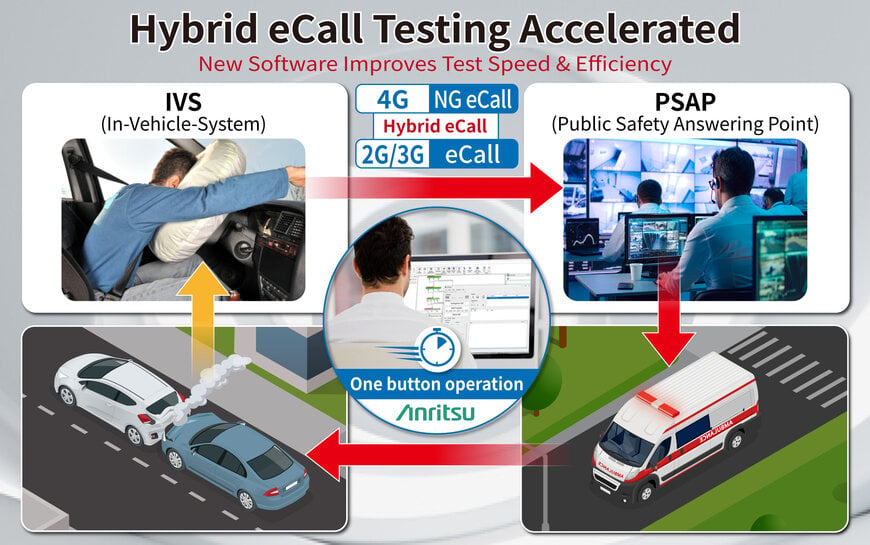
A new automated test solution for Hybrid eCall systems simplifies certification workflows by executing complex multi-stage test sequences through a single interface, reducing overall test time while maintaining reproducibility for automotive safety applications.
Addressing complexity in Hybrid eCall certification
Hybrid eCall systems combine legacy 2G/3G-based emergency calling with Next Generation eCall (NG eCall) over 4G networks, requiring dynamic switching depending on network availability. This dual-mode functionality introduces complexity in validation, as certification must cover multiple communication scenarios, fallback mechanisms, and staged test sequences.
Traditional testing setups rely on manual execution across multiple tools, making outcomes dependent on operator expertise and increasing the likelihood of inconsistencies. These constraints can extend development cycles and complicate compliance with evolving regulatory standards such as EN 18052:2025.
One-button automation and measurable efficiency gains
The introduced solution automates the full Hybrid eCall certification workflow, including communication system switching and multi-stage testing, through a one-button operation. This reduces total test time by approximately 50% compared to conventional methods while maintaining consistent execution conditions.
Automation improves repeatability by eliminating manual intervention, enabling identical test environments across iterations. This is particularly relevant for certification processes, where reproducibility is required to meet regulatory and validation criteria.
The system has been evaluated against EN 18052:2025 requirements by cetecom advanced GmbH, confirming compliance with the standard.
System architecture and technical capabilities
The solution is based on a configurable test platform built around the MD8475B signalling tester, combined with dedicated software modules for eCall, NG eCall, and Hybrid eCall scenarios.
It simulates a Public Safety Answering Point (PSAP), allowing developers to validate in-vehicle systems (IVS) under realistic emergency communication conditions.
A key technical feature is support for Single Radio Voice Call Continuity (SRVCC), which enables seamless handover of VoLTE calls from LTE to legacy 2G or 3G networks. This functionality is critical for ensuring uninterrupted emergency communication during network transitions.
Regulatory context and deployment relevance
The European Union mandated NG eCall capability for new vehicles from 1 January 2026, requiring automotive manufacturers to comply with updated communication and safety standards. However, since 4G coverage is not universal, Hybrid eCall has become essential to guarantee service continuity across regions with mixed network availability.
By enabling efficient validation of hybrid communication behaviour, the solution supports compliance across diverse deployment environments and accelerates certification timelines within the automotive data ecosystem.
Impact on development and validation workflows
The automation of certification testing reduces dependency on specialised operator expertise and allows less experienced personnel to execute complex test scenarios reliably. This contributes to shorter development cycles and more predictable validation outcomes.
The integration of signalling, protocol handling, and test sequencing into a single system also reduces the need for multiple test environments, improving operational efficiency across development, verification, and certification stages.
Position within automotive communication testing
Hybrid eCall validation requires precise coordination between cellular communication protocols, emergency service interfaces, and vehicle systems. Compared to conventional manual test setups, automated platforms provide measurable advantages in execution speed, repeatability, and standard compliance.
As vehicle communication systems evolve toward higher data integration and stricter regulatory oversight, automated certification tools are becoming a necessary component of scalable validation strategies.
Edited by an industrial journalist Sucithra Mani with AI assistance.
www.anritsu.coma
