
www.auto-innovations.net
10
'26
Written on Modified on
Marelli showcases software-defined cockpit innovations at Auto China 2026
Integrated displays, AI, and zonal architecture enable scalable, immersive in-cabin experiences with optimized performance, connectivity, and cost efficiency.
www.marelli.com

Automotive electronics, in-cabin systems, and software-defined vehicles (SDVs) are increasingly shaped by the integration of computing, display, and interior technologies. In this context, Marelli is presenting its next-generation in-cabin solutions at Auto China 2026, held from April 24 to May 3 at the New China International Exhibition Center (Booth W2B08, Hall W2, Beijing).
The showcase focuses on unified cockpit systems, zonal electrical architectures, and advanced connectivity technologies designed to support scalable and cost-efficient SDV platforms.
Unified cockpit combining AI, displays and HMI
At the core of the presentation is a software-defined cockpit architecture that integrates computing, artificial intelligence, graphics, and human–machine interface (HMI) functions into a single system. Built on a QNX real-time operating system, the platform manages mixed-criticality domains such as infotainment, instrument clusters, and cabin intelligence.
This unified approach enables consistent user interaction, reduced system fragmentation, and faster response times across cockpit functions.
Advanced display technologies are a central component of the system. These include ultrathin MiniLED Full Array Local Dimming (FALD) displays for improved contrast and brightness, as well as the HorizonView pillar-to-pillar display, which projects a continuous 44.8-inch image across the base of the windshield. With brightness levels up to 12,000 nits, the system is designed to maintain visibility under varying lighting conditions while presenting information across a wide viewing area.

Zonal architecture for scalable vehicle platforms
The cockpit system is supported by a zonal electrical/electronic (E/E) architecture, which centralises processing and reduces wiring complexity. By shifting functions from distributed electronic control units (ECUs) to zone control units, the architecture lowers system cost and simplifies vehicle design.
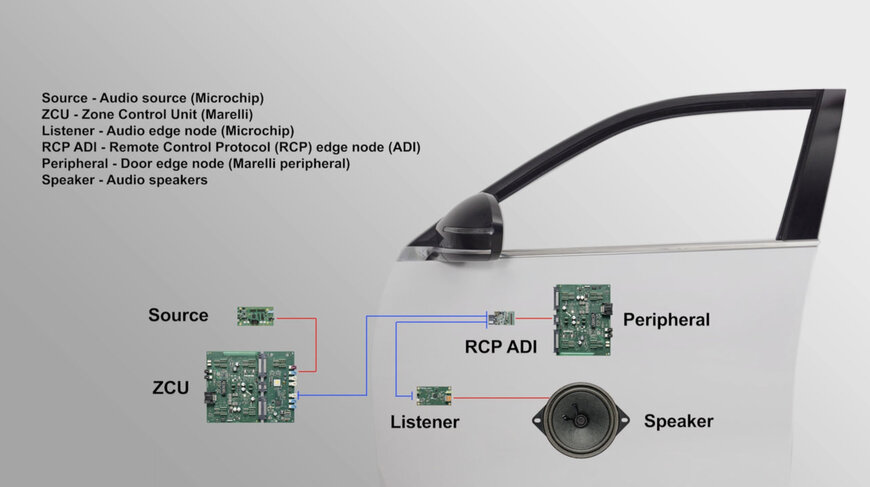
This approach is illustrated through MCU-free modules, including door and seat systems that relocate control functions—such as window operation, seat adjustment, and safety features—into centralised processing units using low-latency communication protocols.
In parallel, zonal audio solutions enable multi-zone sound distribution managed at the system level. A distributed Class-D amplifier over Ethernet supports high-fidelity audio without requiring local digital signal processors or microcontrollers, improving integration and reducing hardware complexity.
5G RedCap connectivity for automotive applications
Marelli is also presenting a 5G RedCap (Reduced Capability) telematics platform tailored for automotive use. Compared to 4G, the system offers higher data rates and lower latency while maintaining similar cost levels.
The platform supports over-the-air updates, remote diagnostics, real-time navigation, and dual-frequency GNSS positioning, enabling reliable connectivity across global vehicle platforms.
Interior technologies for comfort and customization
The exhibit includes interior solutions designed to enhance user experience and vehicle differentiation. These are demonstrated through cockpit and center console concepts incorporating ambient lighting, modular storage, and adaptive components.
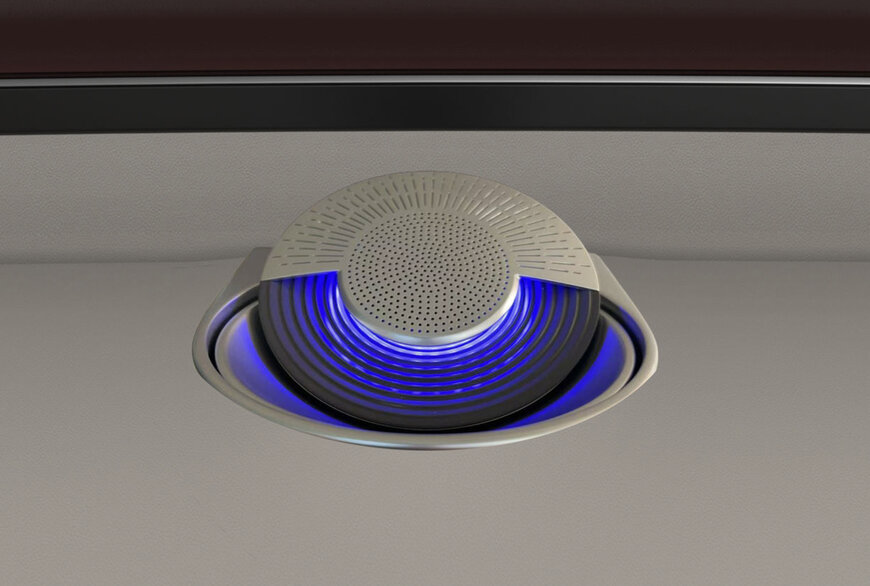
Examples include a motorized speaker for directional audio, a motorized air vent for optimized airflow and energy efficiency, and a retractable table integrated into the cabin design. Additional features such as multi-access console lids and detachable display modules support flexible use of interior space and passenger interaction.
Applications in software-defined vehicles
The technologies presented address key challenges in SDV development, including system integration, scalability, and cost control. By combining zonal architectures with unified software platforms and advanced interfaces, the solutions support the development of adaptable vehicle platforms across different market segments.
Through its presence at Auto China 2026, Marelli demonstrates how integrated in-cabin systems can enhance functionality, user experience, and design flexibility in next-generation automotive applications.
Edited by Natania Lyngdoh, Induportals Editor — Adapted by AI.
www.marelli.com
