
www.auto-innovations.net
03
'26
Written on Modified on
Volvo tests hydrogen trucks for long-haul transport
Volvo Trucks deploys hydrogen combustion trucks to improve fuel efficiency and enable low-emission long-distance operations.
www.volvotrucks.com
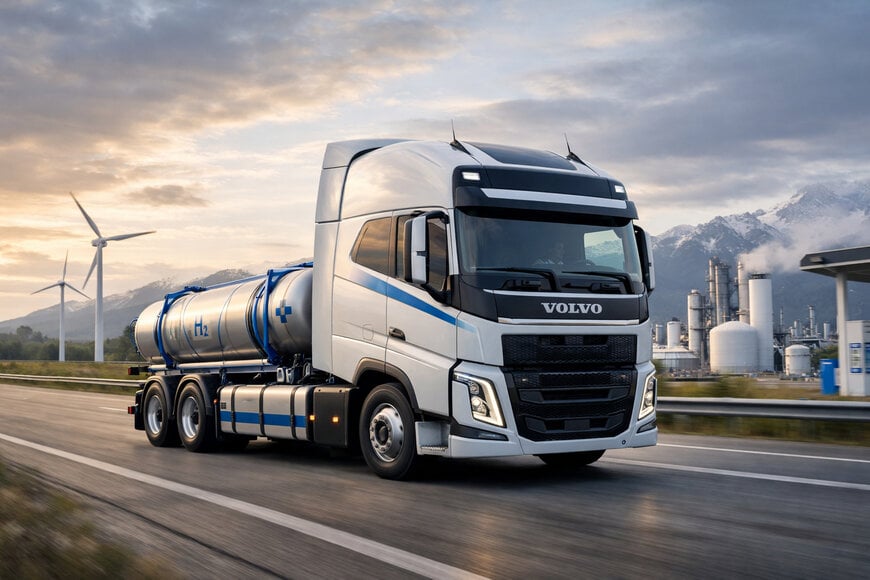
The heavy-duty transport sector is under increasing pressure to reduce CO₂ emissions without compromising operational efficiency, particularly in long-haul applications. While battery-electric trucks are expanding rapidly, their deployment remains constrained in certain regions due to limited charging infrastructure and downtime associated with recharging.
To address these operational constraints, Volvo Trucks has developed hydrogen combustion engine trucks as part of its broader decarbonization strategy. The goal is to provide a solution capable of maintaining diesel-like performance while enabling lower-emission transport over long distances.
Technical solution: Hydrogen combustion with HPDI
The solution is based on a hydrogen-powered internal combustion engine using High Pressure Direct Injection (HPDI), supplied by Cespira. This system initiates combustion through the injection of a small amount of ignition fuel at high pressure before hydrogen is introduced.
This approach allows the engine to operate with compression ignition similar to diesel, resulting in improved energy efficiency and higher performance compared to conventional hydrogen combustion technologies. It also enables operators to use the vehicles in a way that closely resembles existing diesel trucks, reducing the need for retraining or operational changes.
The technology builds on proven experience, with HPDI already deployed in more than 10,000 gas-powered trucks worldwide, supporting reliability and scalability.
Deployment and operational integration
The hydrogen trucks are currently undergoing on-road testing, marking a critical step toward real-world validation. Commercial introduction is planned in Europe before 2030.
The deployment approach is integrated into Volvo’s broader multi-technology strategy, which includes battery-electric, fuel-cell electric, and renewable-fuel combustion solutions. This allows fleet operators to select technologies based on route profiles, infrastructure availability, and energy costs, ensuring operational flexibility during the transition to lower-emission transport.
Selection rationale: addressing operational constraints
Hydrogen combustion technology has been selected primarily for its suitability in long-haul and infrastructure-constrained environments. Unlike battery-electric alternatives, it does not rely on extensive charging networks or long recharging cycles. At the same time, it maintains the performance characteristics such as power, torque, and drivability expected from diesel-powered trucks.
This makes the solution particularly relevant for transport operators seeking to reduce emissions without disrupting established logistics workflows.
Performance expectations and benefits
Testing and development data indicate that the hydrogen combustion trucks can achieve higher energy efficiency and lower fuel consumption compared to traditional hydrogen engines. The use of green hydrogen, combined with renewable ignition fuels such as HVO, creates the potential for net-zero CO₂ emissions on a well-to-wheel basis.
In operational terms, the trucks are designed to meet or exceed typical daily driving ranges for long-haul transport. Their diesel-derived powertrain architecture also contributes to durability and ease of integration into existing fleets.
Operational impact and scalability
The technology offers a pathway for decarbonizing transport in regions where hydrogen infrastructure may scale more rapidly than electric charging networks for heavy-duty vehicles. However, broader adoption will depend on the availability of cost-competitive hydrogen and the expansion of refuelling infrastructure, as well as regional regulatory frameworks.
By positioning hydrogen combustion alongside other zero- and low-emission technologies, Volvo enables a gradual and adaptable transition for fleet operators, reducing dependency on a single energy solution.
Conclusion
The development and testing of hydrogen combustion engine trucks illustrate how existing engine technologies can be adapted to support decarbonization goals. By combining hydrogen fuel with HPDI technology, the solution addresses key challenges in long-haul transport range, refuelling time, and infrastructure while preserving the operational characteristics of conventional diesel trucks.
Edited by an industrial journalist Sucithra Mani with AI assistance.
www.volvogroup.com
