
www.auto-innovations.net
21
'26
Written on Modified on
AMADA integrates forming, stamping and welding for EV motor production
A combined hairpin processing, segmented stator stamping and welding workflow targets higher throughput, yield and joint quality in electric motor manufacturing.
www.amada.eu
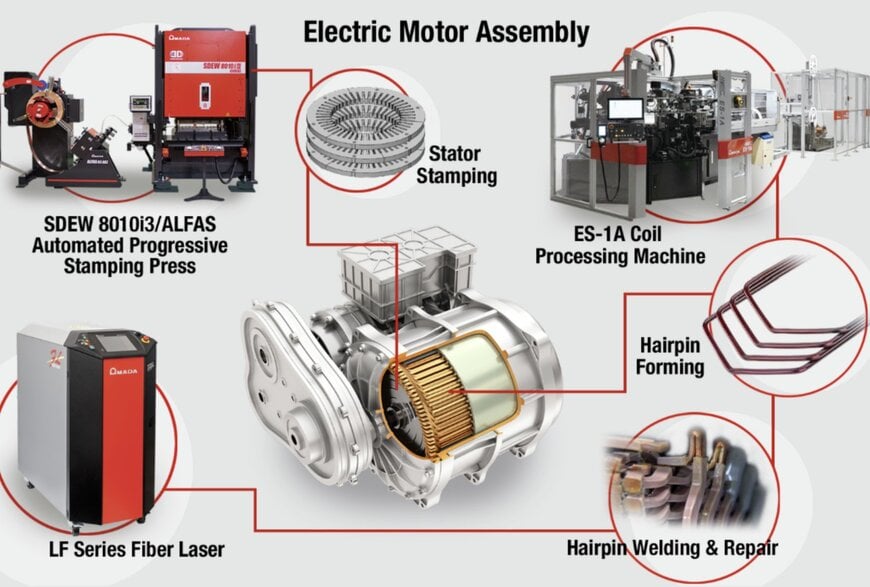
Electric motor production for EV powertrains is shifting toward hairpin winding designs and more automated stator manufacturing, increasing the need for tightly coordinated forming, stamping, and joining steps. AMADA WELD TECH, together with AMADA PRESS SYSTEM, is highlighting an integrated manufacturing approach that links these operations for high-volume motor assembly.
Hairpin windings drive demand for repeatable copper forming and joining
As motor designs move away from traditional round-wire windings, manufacturers are increasingly adopting rectangular copper “hairpins”. These pre-formed conductors are inserted into the stator core, mechanically locked in place, and then joined at their ends—making consistent conductor geometry and reliable end-weld quality critical, especially at scale.
For hairpin preparation, AMADA PRESS SYSTEM’s ES-1A 48-axis coil processing machine is designed to run flat copper wire through a continuous process that combines feeding, straightening, peeling, cutting, bending, and pressing. In production terms, the intent is to reduce variability between conductors and support stable downstream insertion and joining.
A modular stator stamping approach to improve yield and reduce press demand
Stator manufacturing is another pressure point in EV motor lines, where material utilization and press footprint directly impact capex and energy consumption. AMADA PRESS SYSTEM is promoting a modular three-segment stator stamping method as an alternative to single-piece stamping.
The stated manufacturing effects are higher material yield, smaller press size requirements, and lower total energy use—a combination that can help reduce infrastructure requirements for stator production cells. AMADA links this approach to compact, high-precision presses and automated feeding equipment, including the SDEW-i3 GORIKI high-rigidity, high-speed precision press series and the ALFAS-03ARZ high-speed, high-precision NC roll feeder, targeting consistent stamping output without reliance on large-scale press installations.
Multiple welding routes for hairpin end connections
Once hairpins are installed, motor performance and reliability depend heavily on the consistency of end connections. AMADA WELD TECH is positioning three joining options for hairpin ends, each aligned with different production needs and geometry tolerances: laser welding, micro TIG welding, and resistance brazing.
Laser welding is presented as a non-contact method suited to high-speed assembly, and is designed to integrate with vision systems for alignment and quality assurance—relevant in automated lines where positional variation must be corrected in real time. Micro TIG welding is positioned as a flexible alternative for low-volume production or maintenance operations, where cost and adaptability can outweigh peak throughput. Resistance brazing is positioned for strong joints and use cases with more forgiving geometries, where the process window can accommodate dimensional variation.
Why integration matters in high-volume motor manufacturing
Instead of treating copper forming, stator stamping, and joining as separate islands, AMADA is emphasizing the manufacturing value of designing them as a coordinated workflow. The objective is to improve in-line quality control, reduce handling and rework, and maintain process consistency across high-volume EV motor production—where small deviations in conductor prep, stamping accuracy, or weld quality can scale into measurable yield and reliability issues.
AMADA frames this combined capability within AMADA ONE, an initiative intended to unify expertise across AMADA WELD TECH, AMADA PRESS SYSTEM, and other AMADA Group companies, spanning fabrication, stamping, welding, and machining operations.
www.amadaweldtech.com
Hairpin windings drive demand for repeatable copper forming and joining
As motor designs move away from traditional round-wire windings, manufacturers are increasingly adopting rectangular copper “hairpins”. These pre-formed conductors are inserted into the stator core, mechanically locked in place, and then joined at their ends—making consistent conductor geometry and reliable end-weld quality critical, especially at scale.
For hairpin preparation, AMADA PRESS SYSTEM’s ES-1A 48-axis coil processing machine is designed to run flat copper wire through a continuous process that combines feeding, straightening, peeling, cutting, bending, and pressing. In production terms, the intent is to reduce variability between conductors and support stable downstream insertion and joining.
A modular stator stamping approach to improve yield and reduce press demand
Stator manufacturing is another pressure point in EV motor lines, where material utilization and press footprint directly impact capex and energy consumption. AMADA PRESS SYSTEM is promoting a modular three-segment stator stamping method as an alternative to single-piece stamping.
The stated manufacturing effects are higher material yield, smaller press size requirements, and lower total energy use—a combination that can help reduce infrastructure requirements for stator production cells. AMADA links this approach to compact, high-precision presses and automated feeding equipment, including the SDEW-i3 GORIKI high-rigidity, high-speed precision press series and the ALFAS-03ARZ high-speed, high-precision NC roll feeder, targeting consistent stamping output without reliance on large-scale press installations.
Multiple welding routes for hairpin end connections
Once hairpins are installed, motor performance and reliability depend heavily on the consistency of end connections. AMADA WELD TECH is positioning three joining options for hairpin ends, each aligned with different production needs and geometry tolerances: laser welding, micro TIG welding, and resistance brazing.
Laser welding is presented as a non-contact method suited to high-speed assembly, and is designed to integrate with vision systems for alignment and quality assurance—relevant in automated lines where positional variation must be corrected in real time. Micro TIG welding is positioned as a flexible alternative for low-volume production or maintenance operations, where cost and adaptability can outweigh peak throughput. Resistance brazing is positioned for strong joints and use cases with more forgiving geometries, where the process window can accommodate dimensional variation.
Why integration matters in high-volume motor manufacturing
Instead of treating copper forming, stator stamping, and joining as separate islands, AMADA is emphasizing the manufacturing value of designing them as a coordinated workflow. The objective is to improve in-line quality control, reduce handling and rework, and maintain process consistency across high-volume EV motor production—where small deviations in conductor prep, stamping accuracy, or weld quality can scale into measurable yield and reliability issues.
AMADA frames this combined capability within AMADA ONE, an initiative intended to unify expertise across AMADA WELD TECH, AMADA PRESS SYSTEM, and other AMADA Group companies, spanning fabrication, stamping, welding, and machining operations.
www.amadaweldtech.com
