
www.auto-innovations.net
09
'26
Written on Modified on
BMW Intelligent Personal Assistant with Integrated Alexa AI
How BMW Group expands its in-vehicle voice assistant with Amazon Alexa+ for conversational control and broader digital supply chain connectivity.
www.bmw.com
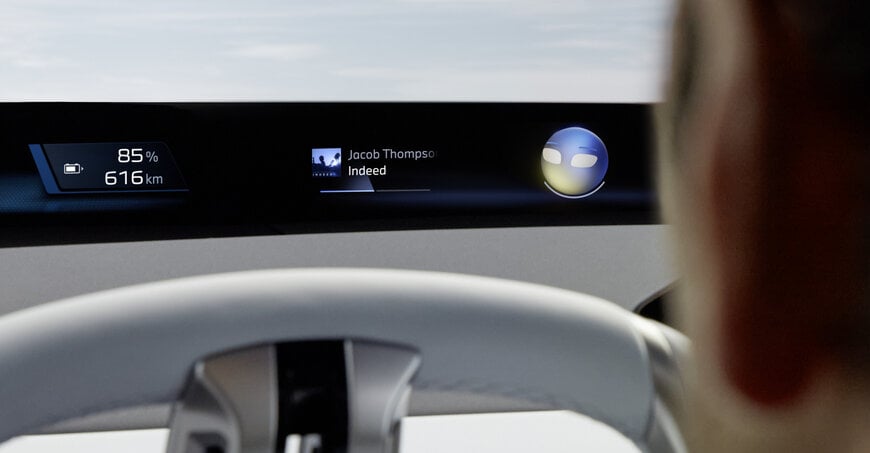
BMW Group has introduced an expanded version of its in-vehicle voice assistant by integrating Amazon’s Alexa+ architecture into the BMW Intelligent Personal Assistant. This enhancement, slated to debut in the new BMW iX3 at CES 2026 in Las Vegas, aims to advance human-vehicle interaction using generative AI and natural language processing for both vehicle function control and access to external information sources. The initial rollout will occur in Germany and the United States in the second half of 2026.
Natural Language Interaction and AI Architecture
The core advancement with the updated BMW Intelligent Personal Assistant lies in its adoption of the Alexa+ AI framework and a large language model (LLM) that supports natural language interaction without reliance on rigid, predefined voice commands. Users can articulate compound requests and follow-up questions as part of a conversational flow, enabling context-aware responses that link general knowledge queries with vehicle actions such as navigation routing. For example, asking for the most famous painting and then instructing the system to navigate to its location is processed as a unified dialogue rather than discrete commands.
This shift represents a transition from intent-based command recognition to generative conversational interaction, aligning with broader trends in the automotive data ecosystem toward integrating AI that interprets user intent and context to inform responses and actions.
Functional Integration and Digital Ecosystem Connectivity
Beyond conversational improvements, the integration allows linking the vehicle’s voice assistant with a user’s Amazon account, facilitating access to music streaming, public news retrieval, and other content types typically accessed via cloud-connected services. The system’s capabilities extend the digital supply chain of infotainment and telematics by enabling real-time access to external content sources within the vehicle environment.
The Alexa+-powered assistant operates within BMW’s Panoramic iDrive interface, underpinned by BMW Operating System X. This software-defined vehicle (SDV) context supports interpretative command execution, user profile linkage, and cloud-based AI service integration.
Deployment Timeline and Model Support
BMW plans to introduce the enhanced Intelligent Personal Assistant across its model range over time, beginning with the BMW iX3. Launch availability will initially cover the German and US markets from the latter half of 2026, with additional regions and models scheduled to follow. The technology aligns with BMW’s ongoing SDV strategy that integrates advanced AI services into the automotive environment through over-the-air updates and system-level upgrades consistent with Operating System 9 and X platforms.
Technical Use Cases and Operational Benefits
In practical applications, the expanded assistant can perform complex tasks spanning interior vehicle control (e.g., climate, navigation, media) and general knowledge inquiries without segmented command syntax. By understanding conversational context, the system can reduce driver burden and streamline interaction workflows, potentially improving operational efficiency and user satisfaction. The integration of AI also enables adaptive learning, where contextual dialogues inform more precise future responses.
The enhancement builds on previous iterations that introduced Amazon Alexa Custom Assistant functionality in 2022 and expanded topic domains for all vehicles with Operating System 9 in 2025, adding music search, sports and news queries, and broader general knowledge access.
Industry Positioning
BMW’s integration of Alexa+ positions it among automotive manufacturers advancing in-vehicle AI assistants capable of conversational interaction. While other manufacturers have introduced voice-enabled services and third-party integrations, BMW’s implementation uniquely combines deep vehicle control with a generative AI capable of cross-domain query handling, contextual understanding, and connection to external digital services via linked user accounts.
The deployment reflects an incremental yet measurable shift in how automotive voice assistants interact with users and external data ecosystems, emphasizing AI interpretability and flexibility over predefined voice command schemas.
The expanded BMW Intelligent Personal Assistant marks a substantive technical evolution in voice interaction within vehicles through the integration of Amazon’s Alexa+ architecture and LLM-based natural language processing. By enabling contextual dialogue, linked digital services, and adaptive learning within the automotive data ecosystem, BMW’s approach illustrates ongoing efforts to embed conversational AI into the software-defined vehicle paradigm for enhanced usability and connectivity.
www.bmwgroup.com
