
www.auto-innovations.net
06
'26
Written on Modified on
Snapdragon Digital Chassis Drives AI-Defined Mobility
Qualcomm Technologies, Inc. highlights expanding adoption of Snapdragon Digital Chassis and agentic AI at CES 2026, reinforcing its role in software-defined vehicles.
www.qualcomm.com
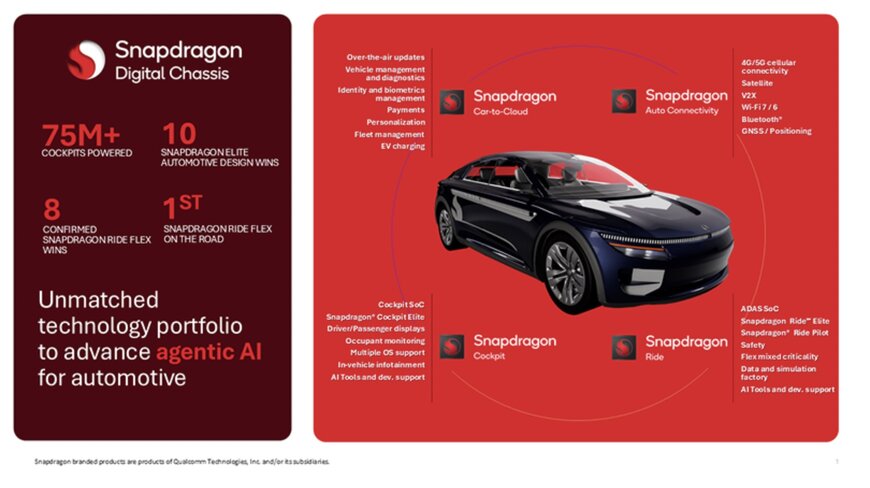
At CES 2026, Qualcomm Technologies emphasized the growing global deployment of its Snapdragon® Digital Chassis™ solutions, showcasing how agentic AI and high-performance compute are accelerating the automotive industry’s transition toward software-defined, AI-driven mobility.
Digital Chassis as a foundation for software-defined vehicles
The Snapdragon Digital Chassis has become a central architectural element for automakers seeking to consolidate vehicle compute, enable over-the-air feature evolution, and support AI-centric workloads across cockpit, connectivity, and automated driving domains. Qualcomm Technologies positions the platform as a scalable foundation that spans vehicle segments and regional markets, supporting long product lifecycles and continuous software innovation.
According to the company, expanding design wins and production deployments underline how centralized compute and AI acceleration are reshaping vehicle development and in-use functionality.
Agentic AI and collaboration with Google
A key CES announcement was the expansion of Qualcomm Technologies’ long-standing collaboration with Google. The companies plan to combine Snapdragon Digital Chassis solutions with Google’s automotive software stack to simplify deployment of next-generation AI features.
This collaboration focuses on accelerating the introduction of agentic AI experiences that allow vehicles to interact more naturally through voice, touch, and visual interfaces, while adapting dynamically to user preferences and driving context.
Cockpit Elite and Ride Elite design wins
Qualcomm Technologies highlighted strong global traction for its Snapdragon Cockpit Elite and Snapdragon Ride Elite platforms, which provide centralized, high-performance compute for AI-defined vehicles. New and expanded collaborations were announced with Li Auto, Leapmotor, Zeekr, Great Wall Motor, NIO, and Chery, bringing total design wins for these platforms to 10 vehicle programs.
Leapmotor also introduced a central automotive computer built on dual Snapdragon Elite (SA8797P) platforms, described as the first controller of its kind using this configuration. In parallel, Garmin selected the Snapdragon Elite automotive platform to power its Nexus high-performance computing solution.
Ride Flex and centralized compute adoption
Snapdragon Ride Flex was positioned as a catalyst for the shift toward centralized vehicle compute. As the first commercialized system-on-chip to unify digital cockpit and ADAS workloads, Ride Flex is already deployed in mass-produced vehicles across eight global programs.
Tier-1 suppliers including Autolink, Desay SV, Hangsheng, and ZYT outlined mass-production plans for integrated cockpit and driver-assistance systems based on Ride Flex, signaling broader industry adoption of unified compute architectures.
Advancing automated driving ecosystems
Qualcomm Technologies is also extending its Snapdragon Ride platform through collaborations with automated driving stack providers such as DeepRoute.ai, Momenta, QCraft, WeRide, and ZYT. These partnerships are intended to support multiple AI approaches and product tiers, leveraging the platform’s open and scalable architecture.
With nearly one million Snapdragon Ride SoCs shipped and additional collaborations announced with ZF and Epec, Qualcomm Technologies highlighted momentum toward production-ready automated driving systems optimized for real-world deployment.
In-vehicle infotainment and cockpit leadership
Building on more than a decade of in-vehicle infotainment and digital cockpit development, Qualcomm Technologies reported that Snapdragon Cockpit Platforms with integrated AI power over 75 million vehicles worldwide as of June 2025.
At CES, the company underscored how agentic AI is extending cockpit capabilities toward more proactive and personalized in-vehicle experiences. This was reinforced by Toyota’s selection of the next-generation Snapdragon Cockpit Platform for the new RAV4, integrating AI-driven features that adapt in real time to driver and passenger needs.
Connectivity and V2X for safer roads
Connectivity innovations also featured prominently. Qualcomm Technologies introduced the Qualcomm® A10 5G Modem-RF, its first 5G Reduced Capability (RedCap) modem, designed to deliver lower-power, lower-cost LTE/5G connectivity for mission-critical automotive services.
In collaboration with Hyundai Mobis, Qualcomm Technologies demonstrated progress in vehicle-to-everything (V2X) technology aimed at improving detection of non-line-of-sight hazards. The solution is designed to enable earlier warnings, smoother braking responses at high speed, and emergency braking at lower speeds where traditional onboard sensors may have limited visibility.
Industry context
Taken together, the CES 2026 announcements illustrate Qualcomm Technologies’ strategy of combining AI, centralized compute, and connectivity into a unified automotive platform. As vehicles evolve into software-defined systems, the company’s expanding ecosystem of OEMs, Tier-1 suppliers, and software partners reflects the accelerating shift toward AI-enabled mobility architectures across global markets.
www.qualcomm.com
