
Drako Introduces Single-ECU Platform for Software-Defined Vehicles
DriveOS HyperSafety from Drako Tech combines hard real-time control, mixed-criticality isolation, and cloud connectivity in a single-ECU automotive computing architecture.
drakotech.ai
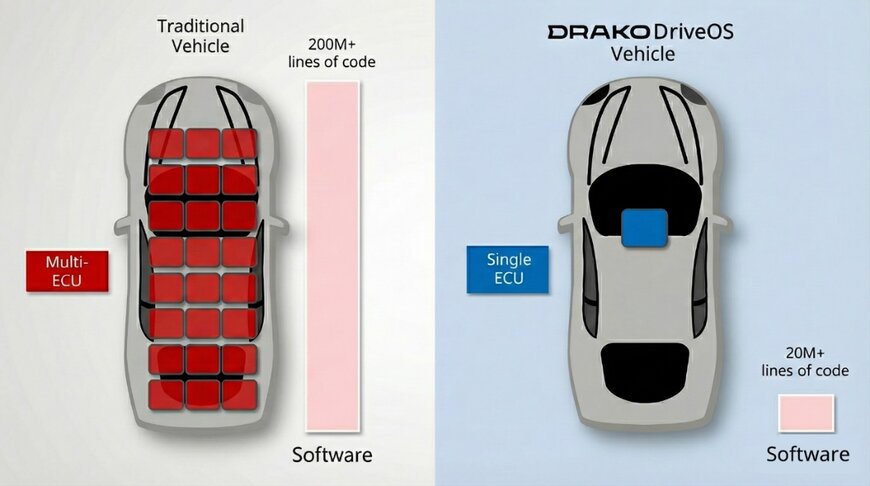
Drako Tech has announced DriveOS™ with HyperSafety, an automotive operating system designed to consolidate vehicle control systems, advanced driver assistance systems (ADAS), and digital cockpit functions onto a single electronic control unit (ECU). The platform targets software-defined vehicle architectures that require deterministic real-time behavior, functional safety, and secure connectivity while reducing system complexity and cost.
Rethinking Automotive ECU Architectures
Conventional vehicle electronics rely on dozens of distributed ECUs to manage propulsion, safety, body electronics, infotainment, and driver assistance functions. While this approach allows functional separation, it increases wiring complexity, integration effort, validation overhead, and hardware cost. It also limits software reuse across vehicle platforms.
DriveOS addresses this challenge by enabling full functional consolidation on a single standard PC-based ECU, while maintaining strict separation between safety-critical and non-critical workloads. The platform supports internal combustion, hybrid, and electric propulsion systems and has been deployed in production vehicles since 2015.
HyperSafety and Deterministic Real-Time Operation
At the core of the platform is HyperSafety, a multi-layer safety architecture designed to guarantee predictable behavior under all operating conditions. DriveOS implements hard real-time scheduling with nanosecond-level control processing, enabling deterministic response times for vehicle dynamics and safety functions.
According to Drako Tech, end-to-end real-time latency is reduced to 108 microseconds, compared with approximately 514 microseconds in typical multi-ECU architectures using Time-Sensitive Networking (TSN) automotive Ethernet. This reduction is achieved through a unified control and networking backbone operating entirely within a single ECU.
Mixed-Criticality Isolation and Redundancy
A key technical challenge in single-ECU designs is ensuring that faults in non-critical software—such as infotainment or connectivity services—cannot affect safety-critical control functions. DriveOS addresses this through a formally verified separation kernel that enforces hardware-backed isolation between virtual ECUs.
The architecture supports both hardware and software redundancy, allowing continued operation even in the presence of multiple component failures. Configurable low-latency failover mechanisms are designed to preserve control continuity for critical vehicle functions.
Linux-Based Platform with Hard Real-Time Guarantees
DriveOS brings hard real-time capabilities to a Linux-based environment without requiring kernel modifications. This approach allows developers to use standard Linux libraries, applications, and tooling while meeting automotive safety and timing requirements traditionally associated with dedicated real-time operating systems.
By combining Linux flexibility with deterministic execution, the platform is intended to simplify software development and validation across control systems, ADAS, and human-machine interface domains.
Integrated Development and Application Support
Drako Tech provides a set of development environments and reference designs that run natively on DriveOS. These include a control systems development environment that supports direct deployment from Simulink models, an ADAS software foundation with support for industry-standard AI platforms, and a configurable digital cockpit framework supporting multi-display systems.
The unified software stack is designed to reduce integration effort and enable reuse across vehicle programs, supporting faster development cycles for software-defined vehicles.
Cybersecurity and Cloud Connectivity
DriveOS incorporates cybersecurity measures based on reduced code footprint, secure hardware partitioning, and on-chip memory communication between isolated subsystems. These mechanisms are intended to limit attack surfaces and simplify safety certification.
The platform supports cloud connectivity for fleet management, remote diagnostics, and over-the-air updates, while maintaining isolation between external interfaces and safety-critical control domains. This enables targeted software updates without requiring full system revalidation.
Positioning in the Automotive Computing Landscape
By combining hard real-time control, mixed-criticality isolation, and Linux-based software flexibility in a single-ECU architecture, DriveOS HyperSafety addresses a core limitation of current automotive electronics. The platform is positioned as an alternative to complex multi-ECU and zonal architectures, offering OEMs a path toward reduced hardware content, simplified integration, and scalable software-defined vehicle platforms.
DriveOS with HyperSafety is available for deployment on existing vehicle architectures, with support for gradual consolidation toward a single-ECU design.
www.drakotech.com
