
Automotive computing platforms for software-defined vehicles
Infineon and Lenovo align microcontroller and domain controller technologies to support ADAS and autonomous driving architectures.
www.infineon.com
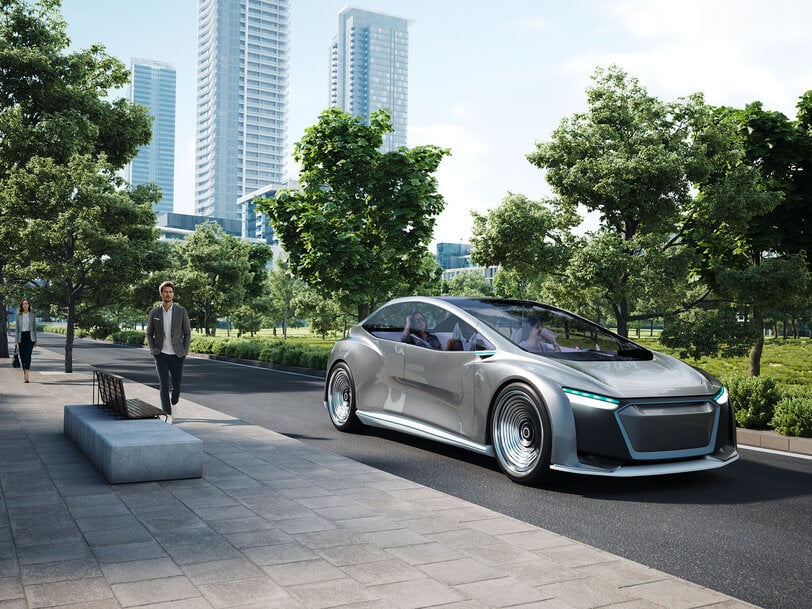
Infineon Technologies AG and Lenovo have expanded their collaboration to integrate Infineon’s AURIX™ automotive microcontrollers into Lenovo’s autonomous driving domain controllers, targeting scalable, safety-oriented computing platforms for software-defined vehicles.
Context: computing requirements for autonomous driving
The transition toward software-defined vehicles (SDVs) is reshaping in-vehicle electronics, with centralized and domain-based computing replacing distributed ECUs. Advanced driver assistance systems (ADAS) and higher levels of driving automation require deterministic, safety-certified control alongside high-performance data processing and fast in-vehicle networking. These requirements place increasing emphasis on functional safety, real-time performance, and secure system integration across heterogeneous compute platforms.
Joint platform architecture
Under the collaboration, Lenovo’s AD1 and AH1 autonomous driving domain controller units will incorporate Infineon’s AURIX™ family of microcontrollers. AURIX MCUs are designed for safety-critical automotive applications and are commonly used for real-time control, monitoring, and redundancy management in complex electronic architectures.
Within the Lenovo platforms, the AURIX devices support tasks related to functional safety supervision, energy management, and high-speed data exchange across in-vehicle networks. This division of labor allows higher-level processors to focus on perception, planning, and AI workloads, while the microcontroller layer ensures deterministic control and compliance with automotive safety requirements.
Support for ADAS and automation levels
The combined solution is intended to support a range of automation levels, from Level 2 partial automation through Level 3 conditional automation and toward Level 4 high automation. This scalability reflects the need for OEMs to deploy common hardware foundations across multiple vehicle programs while differentiating functionality through software.
By pairing safety-oriented microcontrollers with centralized domain controllers, the architecture addresses both real-time control needs and the compute demands of sensor fusion and decision-making algorithms.
Relevance to software-defined vehicle development
A core objective of the collaboration is to accelerate SDV development cycles. Centralized computing platforms with standardized interfaces can reduce system complexity, improve reuse across vehicle lines, and enable more frequent software updates over the vehicle lifecycle.
The Infineon–Lenovo approach emphasizes a modular hardware foundation that can be integrated with software stacks, tools, and services from across the automotive ecosystem. This supports faster iteration during development and validation, while maintaining traceability and safety compliance.
Ecosystem and integration considerations
Beyond the core hardware integration, both companies indicate plans to work with additional partners across the automotive value chain. These collaborations are expected to address system integration, middleware, development tools, and services required to deploy SDV architectures at scale.
Such ecosystem alignment is increasingly important as vehicle architectures converge around common computing platforms that must interoperate with diverse sensors, actuators, and software components.
Implications for automotive computing
The collaboration illustrates a broader trend in automotive electronics: the combination of high-performance domain controllers with dedicated safety microcontrollers to balance flexibility and determinism. For OEMs, this approach provides a pathway to deploy software-defined vehicle platforms that support advanced automation while meeting stringent functional safety and reliability requirements.
By aligning microcontroller-based safety supervision with domain-level computing, Infineon and Lenovo aim to provide a scalable foundation for next-generation automotive computing platforms that underpin the evolution toward connected and autonomous vehicles.
www.infineon.com
