
www.auto-innovations.net
12
'25
Written on Modified on
Semi-public charging network for heavy-duty electric trucks
Daimler Truck expands charging infrastructure with TruckCharge and enables companies to share their depot charging stations.
www.daimlertruck.com
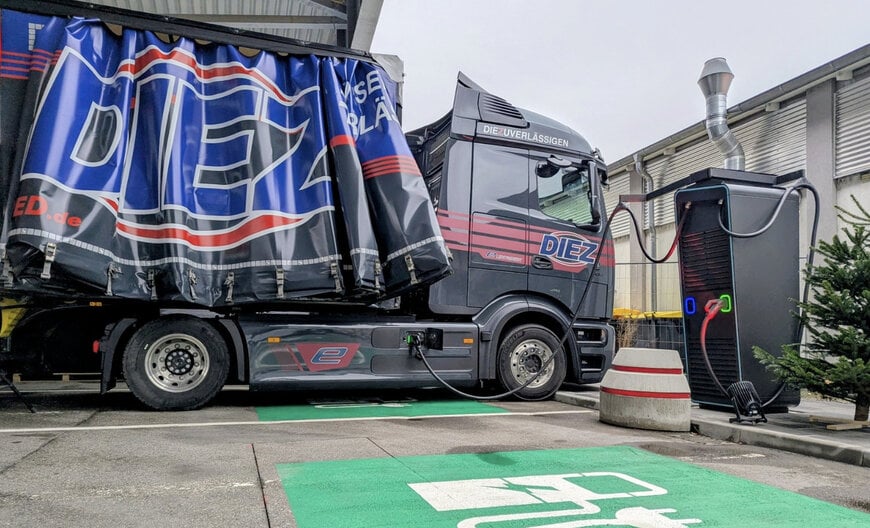
The expansion of charging infrastructure for heavy-duty commercial vehicles is becoming increasingly important for logistics and transport operators. To reduce bottlenecks and make better use of existing resources, Daimler Truck has introduced the semi-public charging network TruckCharge. The first pilot customer, Wessels Logistik in Rhede, has been active since October, followed in December by Spedition Diez in Dettingen unter Teck. The official rollout in Germany and Austria is planned for the first quarter of 2026, with additional European markets to follow later in the year. By 2030, the network is expected to include more than 3,000 fast-charging points across Europe.
How “Semi-Public Charging” expands the use of existing depot capacity
The TruckCharge concept allows companies to make their own charging points available to external users during times when they are not needed internally. This approach helps create a denser network of charging locations for long-haul and regional distribution operations while generating additional revenue for depot operators. Daimler Truck brings together relevant industry stakeholders and provides a Europe-wide platform for planning, booking, reserving, and paying for charging sessions — a key step toward quickly expanding charging infrastructure for battery-electric trucks.
Operational implementation is carried out together with technology partner Spirii, which provides a modular eMobility software platform. This includes a Charge Point Management System (CPMS) for depot operators, eMobility solutions for fleets, and a driver app for initiating and managing charging processes.
Software platform as the backbone of the network
The Spirii platform enables operators to manage, monitor, and selectively share their charging stations. Depot operators maintain full control over access and pricing. The “TruckCharge Connect” solution consolidates the functions required for a combined internal and external user base: charging point search, reservations, transparent pricing, and roaming capabilities for third-party providers. The TruckCharge app gives drivers mobile access and convenient operation on the go.
Together, these tools support the development of a European EV charging infrastructure for heavy-duty vehicles — a segment where regional and depot-based charging opportunities still remain limited, particularly away from major long-haul corridors.
Complementing the public fast-charging network
TruckCharge is designed to complement existing public charging offerings, including those provided by Milence, the joint venture of Daimler Truck, the Traton Group, and the Volvo Group. Milence focuses on fast-charging stations along highways and major traffic routes. The semi-public depot network aims to supplement these corridors with regional and depot-based charging points, increasing planning flexibility for electric truck operations.
Pilot customers from real-world logistics operations
Spedition Diez operates a charging park in Dettingen unter Teck, supporting a fleet of around 60 heavy-duty vehicles. The company specializes in volume and special transports and maintains extensive warehousing capacity, including a heavy-load hall equipped with a 50-ton crane. Wessels Logistik in Rhede runs system transport operations in addition to walking-floor and bulk material transport services. With around 100 of its own trucks and 15,000 square meters of logistics space, the company now also uses its infrastructure for external vehicles as part of the TruckCharge network.
Significance for the transport sector
The limited availability of suitable charging points remains one of the main barriers to the adoption of battery-electric heavy-duty trucks. The semi-public concept addresses this constraint by making existing depot capacity accessible to more users while providing operators with an additional revenue stream. As a result, transport companies face lower barriers when transitioning to electric fleets, while the broader charging network becomes more dense and scalable.
www.daimlertruck.com
