
www.auto-innovations.net
28
'26
Written on Modified on
Rosenberger Introduces Compact HVR55 Connector for E-Mobility
The 1,200V system reduces complexity and optimizes automated wiring harness assembly in electric vehicles.
www.rosenberger.com
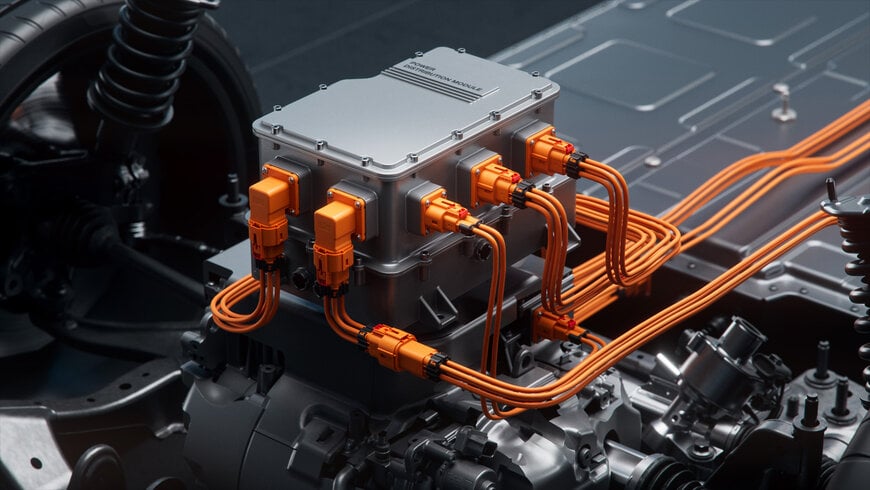
Rosenberger has expanded its portfolio with the HVR®55, a shielded high-voltage connector system designed specifically for modern electric vehicle architectures. The compact solution aims to minimize space requirements and enable seamless integration into automated wiring harness production. Through the optimized design of the connector and wiring harness, material usage, vehicle weight, and ultimately, overall system costs can be reduced.
High-Performance and Flexible Integration
Designed for operating voltages up to 1,200 V DC, the HVR®55 offers a current-carrying capacity of up to 60 A at an ambient temperature of 85 °C. The system covers a wide temperature range from −40 °C to +140 °C and is designed for cable cross-sections of 4 mm² and 6 mm². The product portfolio includes two- and four-pole versions, including cable connectors for single-core cables, inline connections, and pin headers for cables and busbars (also available angled at 90°). This flexibility makes the system ideal for critical high-voltage interfaces, such as between the power distribution unit (PDU) and auxiliary units, or between the on-board charger (OBC) and the traction battery.
Assembly Safety in Automotive Environments
To ensure reliability during harsh vehicle operation, the connector features a mechanical CPA (Connector Position Assurance) that prevents unintentional disconnection. The components meet strict automotive vibration specifications according to USCAR V1 and LV 215. When mated, the system achieves an IP6K9K protection rating (protection against high-pressure and steam jet cleaning). Even when unmated, the RoHS-compliant system offers IPXXB+ touch protection, guaranteeing maximum safety for personnel during the assembly and maintenance of the high-voltage electrical system.
Additional Context: High Voltage Interlock Loops (HVIL) and Automated Assembly
This section details electrotechnical specifications and manufacturing details not included in the original press release.
In electromobility, the optional High Voltage Interlock Loop (HVIL) is a critical safety feature. It is a separate low-voltage control circuit physically integrated into the high-voltage connector. When disconnecting, the HVIL contacts are mechanically designed to always break a few milliseconds before the live high-voltage contacts. The battery management system (BMS) registers this interruption in real time and immediately shuts off the direct current (DC) via the main contactors before a life-threatening and material-destroying arc can occur at the separating high-voltage contacts—a mandatory requirement at voltages up to 1,200 V DC.
Furthermore, processing thick, multi-shielded high-voltage cables presents massive challenges for wiring harness production. Traditional connectors often require complex, manual stripping and shield-contacting processes. A design optimized for automation means the connector supports axial joining processes and features tolerances that can be handled by modern cable processing machines without manual intervention, drastically increasing scalability for the large-scale production of EVs.
Edited by industrial journalist Lekshman Ramdas, with AI assistance.
www.rosenberger.com
