
www.auto-innovations.net
26
'26
Written on Modified on
Zonal Architecture Hall Effect Switch Technology
Melexis introduces the MLX92342 2-wire Hall effect switch, solving wiring complexity and safety demands in modern zonal automotive architectures.
www.melexis.com
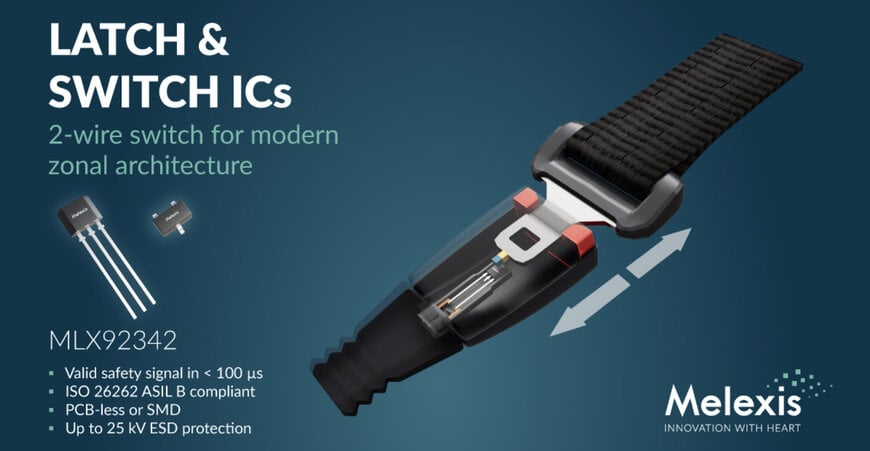
As vehicle electronics transition toward distributed zonal architectures, centralized electronic control units require advanced remote sensing components that minimize harness weight while satisfying stringent functional safety mandates. To address this engineering bottleneck, Melexis has developed the MLX92342, a programmable 2-wire PCB-less Hall effect sensor engineered for safety-critical position and latch detection across automotive and industrial applications.
Engineering Challenges in Distributed Zonal Architectures
Modern vehicle platforms increasingly consolidate processing power into central and zonal electronic control units, pushing sensing functions out to physical endpoints. Traditional three-wire sensors and mechanical microswitches introduce excessive wiring harness complexity, weight, and failure points when deployed across numerous remote locations. Furthermore, safety-critical functions demand rapid diagnostic feedback and high immunity to electrical disturbances without requiring a local printed circuit board at every measurement point.
Operating Principle and System Architecture
The MLX92342 operates as a monolithic sensor IC that detects perpendicular or lateral magnetic fields and translates the physical state into a variable supply current over a two-wire interface. By modulating its supply current according to the magnetic field state, the device eliminates the need for a separate signal wire, directly reducing harness complexity compared with conventional legacy architectures. Developed as a safety hardware element out of context in compliance with ISO 26262, the sensor supports ASIL B system designs by integrating comprehensive on-chip diagnostic mechanisms.
In the event of a fault, the sensor transitions into a dedicated safe state reported via a precise current level, allowing the host electronic control unit to distinguish between normal switching operations and hardware anomalies. The device achieves a valid safety signal response in under 100 microseconds, ensuring minimal latency during system startup checks and active monitoring cycles. Engineers can select between a sequential diagnostic mode tailored for end-position sensors like seatbelt buckles or a parallel diagnostic mode optimized for high-speed motor commutation and latch tracking.
Configurability and Technical Specifications
The sensor provides wide functional versatility by supporting programmable operation as a magnetic latch, unipolar switch, or omnipolar switch. It accommodates a broad magnetic operating range spanning from 0.5 millitesla to 200 millitesla, accommodating diverse magnet strengths, mechanical tolerances, and air gaps. Optional Integrated Magnetic Concentrator technology enables lateral magnetic sensing for constrained packaging environments where perpendicular field detection is impractical.
Key technical specifications include an operating voltage range from 2.7 volts to 28 volts and an ambient operating temperature range spanning from -40 degrees Celsius to +150 degrees Celsius. Temperature compensation is fully configurable from -2000 ppm per degree Celsius to 0 ppm per degree Celsius. Robust electrical protection features encompass reverse supply voltage protection, thermal protection, under-voltage reset, and advanced electrostatic discharge resilience, including 15 kilovolts system-level contact discharge and 25 kilovolts indirect discharge capability. Package configurations include TSOT23-3L surface-mount, TO92-3L through-hole, and PCB-less TO92-3L variants featuring an integrated capacitor.
Industrial Use Cases and Deployment
The combination of PCB-less integration, high-speed diagnostics, and environmental robustness qualifies the sensor for demanding automotive and industrial deployments. Primary applications include seatbelt buckle detection, brake fluid level monitoring, door and charge port locks, active air skirts, and window lifter motor commutation. Highlighting the engineering advantages of the platform, Minko Daskalov, Product Line Director at Melexis, noted that the device integrates PCB-less implementation, higher accuracy, strong electrostatic discharge performance, and a valid safety signal in less than 100 microseconds, providing a high-performance remote sensor for zonal endpoint applications.
Additional Context:
This section details technical specifications and competitive benchmarking not included in the original product announcement.
Traditional position sensing in industrial and automotive environments relied heavily on mechanical microswitches and reed switches, which are prone to mechanical wear, contact degradation, and environmental contamination over extended operational lifecycles. Compared to conventional mechanical alternatives, solid-state Hall effect sensors offer contactless operation that eliminates mechanical fatigue, substantially increasing operational lifespan. While legacy two-wire and three-wire magnetic switches frequently lacked advanced on-chip diagnostics or required external printed circuit boards to process safety signals, modern ISO 26262 compliant architectures demand integrated fault detection. The adoption of programmable magnetic thresholds and customer end-of-line programming via the VDD pin further distinguishes the MLX92342 from fixed-function predecessors, enabling manufacturers to calibrate out mechanical assembly tolerances during final production testing.
Edited by Sucithra Mani, Induportals editor – adapted by AI.
www.melexis.com
