
www.auto-innovations.net
19
'26
Written on Modified on
InfiMotion Europe CEO on China speed and electric drives
Albert Pettersson explains how European automakers can leverage rapid prototyping, 900V architectures, and software-defined vehicle platforms.
www.infimotion.com
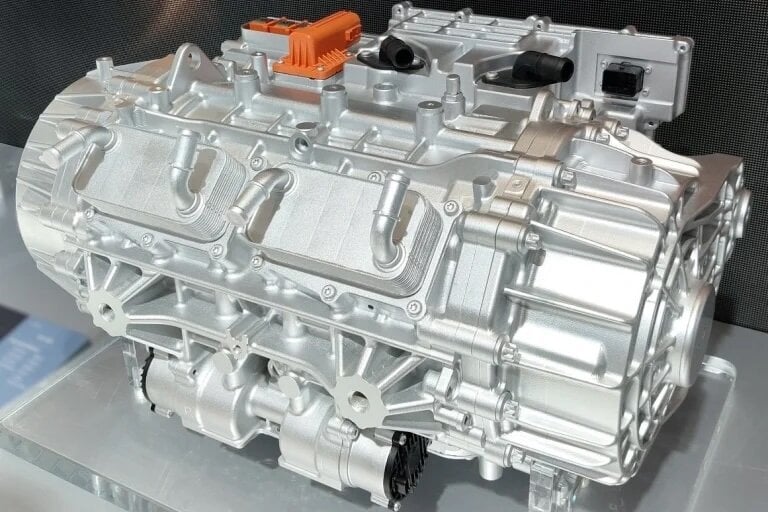
European automakers are facing unprecedented pressure to accelerate development cycles and match the rapid pace of global innovation. In this exclusive interview, Albert Pettersson, CEO of InfiMotion Technology Europe, breaks down how the industry can adapt to "China speed," the critical role of software-defined architectures, and why the push for 900V systems is fundamentally changing electric vehicle design.
European automakers are under increasing pressure to shorten development cycles. What are the biggest lessons Europe can learn from China’s approach to vehicle development?
The biggest lesson is that speed must be built into the entire development model. In China, we see shorter decision paths, more parallel development of hardware and software, and a greater reliance on proven platforms rather than developing every component from scratch for each new vehicle program. At InfiMotion, we combine that speed, industrial scale, and cost efficiency with software development and customer engineering located directly alongside European OEMs. We work intimately with our customers to adapt mature, proven technologies to their specific vehicle architectures.
You often speak about speed becoming a key competitive advantage. How is this changing the way new vehicles and technologies are developed?
Speed is shifting vehicle development from a traditional sequential process to one where hardware, software, validation, and industrialization happen concurrently. We are also seeing aggressive integration, combining multiple functions into increasingly compact systems.
Another crucial driver behind "China speed" is the ability to develop prototypes rapidly. Beyond moving faster through project milestones, rapid prototyping encourages greater risk-taking and more ambitious technological leaps. If a prototype fails a testing phase, there is still time for several more development iterations. This allows companies to move much faster while maintaining a high willingness to innovate, provided they have a well-established supply chain to support it.
The evolution of X-in-1 technology perfectly illustrates this pace. Not long ago, 3-in-1 electric drive systems were considered highly integrated; we then moved to 8-in-1, 11-in-1, and 12-in-1. Now, we are already delivering 16-in-1 solutions. The primary challenge is no longer just developing the next technology, but building agile architectures and organizations capable of continuously evolving alongside it.
Software-defined vehicles (SDVs) are transforming the automotive landscape. What are the most important opportunities and challenges for manufacturers in this transition?
The greatest opportunity is that a vehicle no longer has to be a finalized, static product when it leaves the factory. Software enables manufacturers to optimize performance, efficiency, and functionality throughout the vehicle’s entire lifecycle, while dramatically accelerating the rollout of new features. For suppliers like InfiMotion, this necessitates deep, systemic integration between power electronics, electric drive hardware, control software, and vehicle-level engineering.
The primary challenge is complexity. Hardware and software can no longer be developed in isolated silos; they must be designed as a unified system from day one. This requires entirely new architectures, modern workflows, and much closer collaboration between OEMs and Tier 1 suppliers. For many legacy automakers, transitioning to SDVs is just as much an organizational challenge as it is a technological one.
InfiMotion recently showcased several innovations around 900V architectures. What tangible benefits do these higher-voltage platforms bring to future EVs?
The main driver behind the shift to higher voltages is automaker demand for faster charging. Charging infrastructure typically has a hard cap on maximum current delivery, so doubling the system voltage effectively doubles the charging power without increasing the current. While higher-voltage architectures can also improve overall performance and efficiency, those are secondary benefits, as 900V systems inherently increase drivetrain costs. Because of this cost dynamic, we expect 400V and 450V architectures to coexist alongside 800V and 900V systems rather than being entirely phased out.
The true potential is unlocked when higher voltage is paired with extreme system integration. Our TP501 900V coaxial dual-drive system merges high-voltage technology with a highly integrated, lightweight physical architecture. The ultimate goal is not to adopt higher voltage for its own sake, but to leverage it to improve power density, weight, and charging performance, carefully balancing these gains against the strict cost constraints of future vehicle platforms.
Looking ahead, which technologies or industry trends will have the greatest impact on the next generation of electric vehicles?
We are going to see hyper-integration. In the electric drivetrain, the shift from separate components to highly integrated X-in-1 drive systems is accelerating, packing more functions into smaller, lighter, and more efficient footprints. Simultaneously, 900V architectures will normalize higher power outputs and drastically reduced charging times.
Another highly disruptive trend is sodium-ion battery technology, which has the potential to reduce battery pack costs by approximately 30 percent compared to current lithium-ion cells. This economic shift could eventually make the next generation of electric vehicles cheaper to produce than comparable combustion-engine vehicles.
Software centralization will be equally critical. As more vehicle functions migrate into centralized computing platforms, performance will be continuously optimized over the air. Finally, charging infrastructure will dictate market penetration. As the industry looks to convert EV buyers living in multi-family apartment buildings, access to reliable, smart, and bidirectional charging infrastructure will become the most significant hurdle—and opportunity—over the next few years.
About Albert Pettersson
Albert Pettersson serves as the CEO of InfiMotion Technology Europe, leading the company's strategic expansion, engineering initiatives, and OEM partnerships across the European automotive sector. With a strong background in advanced powertrain development and scalable manufacturing, Pettersson bridges the gap between high-volume, rapid-iteration Asian supply chains and the stringent, software-driven engineering demands of legacy European automakers. Under his leadership, InfiMotion Europe focuses on delivering highly integrated electric drive systems and next-generation high-voltage architectures designed to accelerate the global transition to electric mobility.
Additional Context: SiC inverters in 900V X-in-1 electric drives
This section details technical specifications and competitive benchmarking not included in the original product announcement.
The transition from 400V to 800V and 900V EV architectures fundamentally alters the power electronics within modern electric drive units (EDUs). Traditional Silicon (Si) IGBTs struggle with severe switching losses at these elevated voltages. To achieve the extreme efficiencies required for 900V systems, Tier 1 suppliers utilize Silicon Carbide (SiC) MOSFETs within the inverter. SiC allows for much higher switching frequencies with significantly reduced thermal dissipation. When packaged into a highly integrated "16-in-1" architecture—which consolidates the traction motor, SiC inverter, reduction gear, onboard charger (OBC), DC-DC converter, and thermal management modules into a single cast housing—the physical footprint and heavy high-voltage wiring mass are drastically reduced. This electro-mechanical integration minimizes parasitic losses and maximizes overall power density (kW/kg), allowing automakers to utilize smaller battery packs without sacrificing vehicle range or performance.
Edited by an industrial journalist, Lekshman Ramdas, with AI assistance.
www.infimotiontec.com
