
www.auto-innovations.net
17
'26
Written on Modified on
Additive Manufacturing Speeds Custom Exhaust Production
Ferrita Sweden AB used wire laser metal deposition to accelerate the production of a bespoke exhaust system for a Mercedes-Benz SLR McLaren while reducing manufacturing costs.
www.meltio3d.com
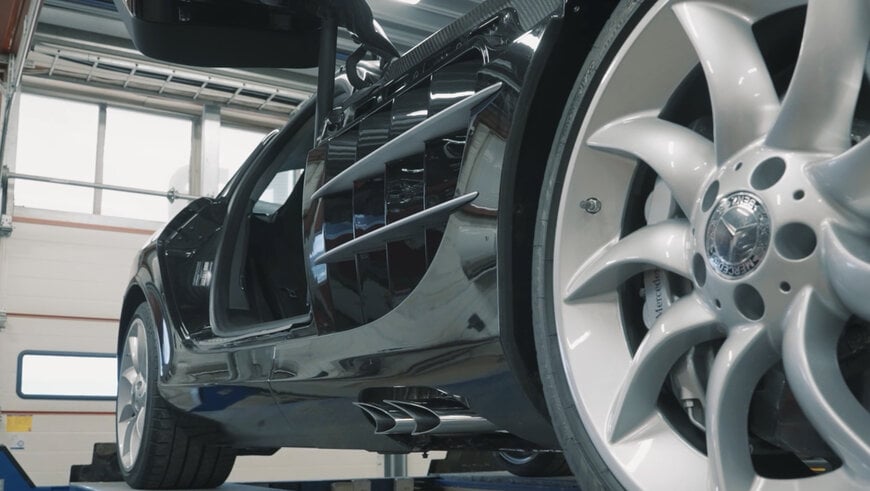
Ferrita Sweden AB develops and manufactures technical solutions for sound attenuation, vibration control, thermal insulation and exhaust gas purification. Serving the aftermarket automotive sector, the company specializes in custom exhaust systems for high-performance and project vehicles where unique designs and precise engineering are essential.
Manufacturing bespoke components under tight deadlines
A customer commissioned Ferrita to develop a completely customized exhaust system for a 2003 Mercedes-Benz SLR McLaren. The objective was to redesign the hand-built supercharged V8 exhaust while maintaining the vehicle's original design language, reducing weight and improving exhaust flow.
Producing four identical tailpipes with complex geometry presented a significant manufacturing challenge. Conventional fabrication methods would have required dedicated tooling to achieve the required symmetry, increasing both production costs and lead times. Since aftermarket projects are typically completed within approximately one week, lengthy tooling processes were not practical.
Combining design freedom with engineering precision
The project required more than visual integration. The replacement exhaust components had to fit within the limited installation space originally designed by the vehicle manufacturer, where much of the exhaust system is packaged inside the front fenders.
The engineering team also focused on improving exhaust gas flow while reducing back pressure. Achieving these objectives required smooth internal geometries that are difficult to manufacture using traditional fabrication techniques.
Ferrita technician Viktor explained the technical advantage:"You can't hand-produce a pair of merge pipes with round ends, flow-wise. You can make perfect merge pipes."
Digital workflow supports rapid production
To shorten development time, Ferrita implemented a fully digital workflow. Engineers first scanned the underside of the vehicle to capture the available installation space and create an accurate CAD model. Before manufacturing the final metal components, the team produced a plastic prototype within a few hours to verify fitment and ensure the new exhaust matched the vehicle's exterior lines.
For final production, Ferrita used a Meltio Robot Cell integrating an ABB industrial robot with a wire laser metal deposition process. The system employs nine laser beams to melt standard welding wire and build metal components layer by layer.
The tailpipes were manufactured from 316 stainless steel. During production, the system operated at a deposition speed of approximately 10 mm/s with a shielding gas flow of 15 l/min while using a laser power of 1000 W to achieve the required dimensional accuracy.
Why Ferrita selected wire laser metal deposition
Ferrita adopted wire laser metal deposition because it eliminated the need for dedicated tooling while allowing complex geometries to be manufactured directly from digital models.
The technology also enabled optimized internal flow paths that would have been difficult to fabricate conventionally. In addition, the process supports multiple materials within a single component, allowing high-temperature alloys such as Inconel to be deposited near the turbocharger before transitioning to stainless steel in less demanding sections.
According to the engineering team:"It is very easy to make a part. A collector, for example. A four into one, ready overnight."
Reduced costs and faster delivery
The additive manufacturing process produced measurable improvements throughout the project.
Ferrita reported approximately a 50% reduction in both manufacturing time and production cost compared with conventional tooling methods. Manufacturing the stainless steel tailpipes required only four to five hours.
By eliminating dedicated tooling, production costs were reduced from an estimated €4,000 to roughly half that amount, including finishing and polishing operations.
The wire-based process also minimized material waste because nearly all deposited wire became part of the finished component.
Replacing the original muffler reduced vehicle weight by approximately 20 kilograms while enabling improved exhaust flow through optimized internal geometries.
Supporting faster custom vehicle development
The combination of 3D scanning, CAD modelling, rapid prototyping and wire laser metal deposition enables Ferrita to move efficiently from concept to finished installation while maintaining the flexibility required for bespoke automotive projects.
For aftermarket manufacturers producing low-volume, highly customized components, additive manufacturing offers a practical alternative to conventional tooling by shortening development cycles, reducing production costs and enabling geometries that improve component performance.
Edited by Sucithra Mani, Induportals editor – adapted by AI.
www.meltio3d.com
