
www.auto-innovations.net
19
'26
Written on Modified on
Cloud-Based Hazard Detection Integration for Vehicle Safety
The BMW Group has adopted Bosch's Road Hazard Service to provide predictive warnings and improve road safety through smart data fusion.
www.bosch.com
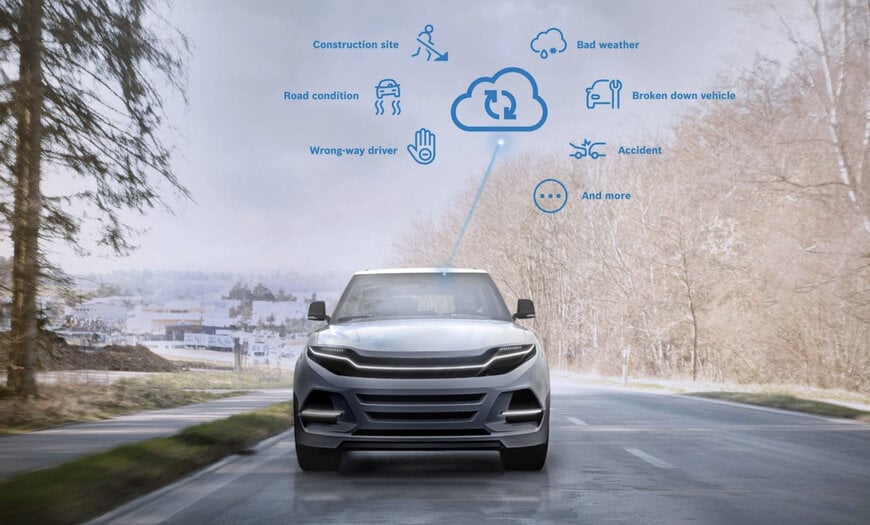
Driving safety depends largely on the ability to anticipate and react promptly to unforeseen critical situations, such as fog banks, heavy rain, black ice, or accidents. Traditional on-board vehicle systems often fail to provide predictive warnings with sufficient lead time, as they rely exclusively on local sensors. To overcome this limitation and reduce the risk of accidents, automotive manufacturers require solutions capable of aggregating real-time data from multiple sources, alerting drivers before an emergency occurs.
Implementation of a Predictive Cloud Platform
To address this need, the Road Hazard Service technology developed by Bosch was implemented. This cloud-based software service collects and analyzes real-time data to flag potential hazards along the route. Since its market launch, the solution has been progressively integrated into millions of commercial vehicles and passenger cars across Europe and the United States.
Starting in March 2026, the BMW Group has also integrated this service into its fleets. The models currently utilizing the technology include the BMW iX1, iX2, iX3, and X3, as well as several Mini brand vehicles. A key element of this implementation is architectural flexibility: automakers can adjust the system's sensitivity and decide at what severity level to trigger the alert, in accordance with their own technical specifications and guidelines.
"Our cloud-based service is a tangible benefit for our customers because it anticipates hazards on the route and informs motorists and truck drivers, helping them avoid critical situations," explains Markus Heyn, member of the Bosch Board of Management and Chairman of the Bosch Mobility business sector.
Smart Data Fusion and Advanced Features
The technological infrastructure of the service relies on a high-reliability concept known as smart data fusion. The cloud algorithm continuously analyzes and combines anonymized data from the sensors of a global fleet of millions of vehicles, such as the activation of the dynamic stability control (DSC) system or the operating frequency of windshield wipers. This information is merged with external data provided by third-party weather services and operational data from road infrastructure operators.
In practice, if numerous vehicles in a specific area activate their windshield wipers at maximum speed and the weather service reports heavy rainfall, the system deduces an imminent risk of aquaplaning and sends an alert.
Additionally, the platform integrates a Wrong-way driver warning. This exclusive technology identifies drivers traveling in the wrong direction and sends instant warnings to the dashboard display or via a smartphone app, providing crucial seconds to react even before the danger becomes visible.
Operational Benefits and ADAS Integration
The accuracy of the predictions is constantly verified using a Bosch reference fleet equipped with special sensors and cross-referenced with external visual sources, such as traffic webcams.
Beyond providing direct information to the driver, the data generated by the Road Hazard Service can interface with advanced driver assistance systems (ADAS), such as adaptive cruise control (ACC) or automatic emergency braking. This allows the vehicle's active systems to use predictive alerts to react with greater precision and safety. Among the developments associated with this connectivity is also connected speed limit detection, which dynamically updates on-board signage in the presence of roadworks, wet roads, or time-based restrictions.
Edited by Maria Brueva, Induportals editor – adapted by AI.
www.bosch.com
