
www.auto-innovations.net
31
'26
Written on Modified on
Teleoperated shuttles tested for urban mobility
Rheinmetall AG, MIRA GmbH and Rheinbahn AG launch a pilot in Düsseldorf to evaluate remote driving for cost-efficient on-demand transport.
www.rheinmetall.com
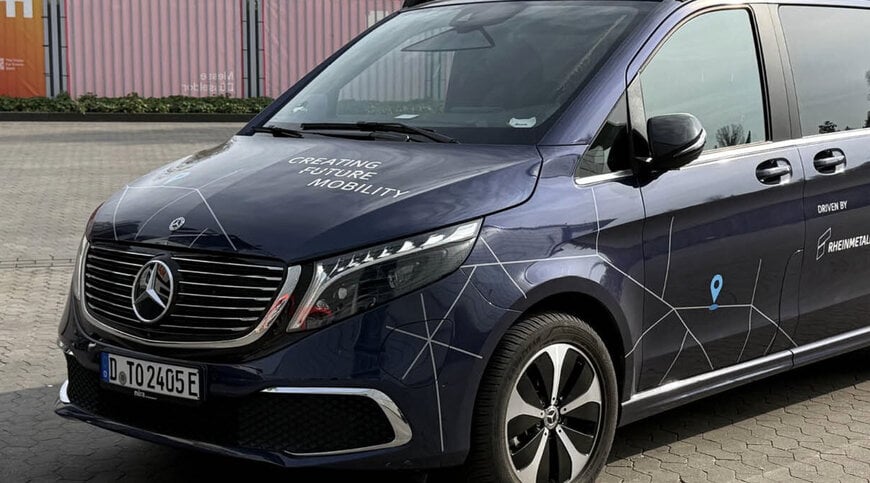
Urban transport operators are facing increasing pressure related to staffing shortages, rising operational costs and the need to maintain reliable service levels. In response, Rheinmetall AG, MIRA GmbH and Rheinbahn AG have initiated a pilot project to test teleoperated on-demand shuttles under real-world conditions.
The project, announced during XPONENTIAL Europe, will deploy remotely operated vehicles on public roads in Düsseldorf starting in May 2026. The route will connect the airport railway station, the EUREF Campus and the terminal at Düsseldorf Airport.
The objective is to assess whether teleoperation can provide a scalable and economically viable solution for future public transport systems.
Solution: remote operation as a mobility enabler
The pilot focuses on the deployment of teleoperated vehicles controlled from a remote operations center by certified drivers. During the testing phase, a safety driver will remain on board to ensure operational security.
Teleoperation is being evaluated as a key technology to enable flexible, on-demand mobility services without requiring a driver physically present in each vehicle. This approach is particularly relevant in addressing workforce constraints while maintaining service continuity.
The project examines system performance across several operational dimensions, including safety, integration into existing traffic environments, passenger acceptance and overall cost efficiency.
Deployment: real-world testing in public traffic
Unlike controlled pilot environments, this initiative is designed for operation on public roads, allowing stakeholders to evaluate the technology under realistic traffic conditions. The integration with existing infrastructure and control systems is a central aspect of the deployment.
Annette Grabbe, CEO of Rheinbahn AG, explains: “Public transport is facing structural challenges regarding staffing and financing. If we want to ensure reliable service, we must systematically explore technological options.”
She adds: “The pilot operation of teleoperated on-demand shuttles on public roads is an important step. Based on robust data, we will assess whether and how teleoperation can become a permanent part of our operating model.”
Technology backbone: secure and scalable digital infrastructure
The pilot is supported by an integrated system combining secure cloud infrastructure, IoT platforms and real-time fleet management. This architecture enables continuous communication between vehicles, operators and control systems, ensuring low latency and high availability.
By linking operational data and control functions in real time, the system supports safe remote driving while laying the groundwork for scalable fleet deployment.
Win Neidlinger, CEO of MIRA GmbH, states: “With our teleoperation solution, we are contributing to a future-proof public transport system. This pilot marks an important step toward real-world implementation.”
Results and expected impact
While the pilot phase is primarily focused on validation, it is expected to generate data on operational reliability, cost structures and user acceptance. These insights will inform decisions on broader deployment in public transport, as well as potential applications in logistics and agriculture.
From a strategic perspective, teleoperation offers a pathway to reduce dependency on on-site drivers, optimize fleet utilization and improve service flexibility.
Framework: part of a European research initiative
The pilot is part of the PoQuaSIA research project, funded by the German Federal Ministry for Economic Affairs and Energy within the European 8ra initiative. The program aims to develop resilient and scalable digital infrastructures for safety-critical applications.
Conclusion
The deployment of teleoperated shuttles in Düsseldorf illustrates how digital technologies can address structural challenges in public transport. By combining remote operation with secure, real-time infrastructure, the project explores new models for efficient and scalable mobility services.
Its outcome will determine whether teleoperation can transition from pilot testing to a viable component of future urban transport systems.
Edited by Maria Brueva, Induportals editor – adapted by AI.
www.rheinmetall.com
